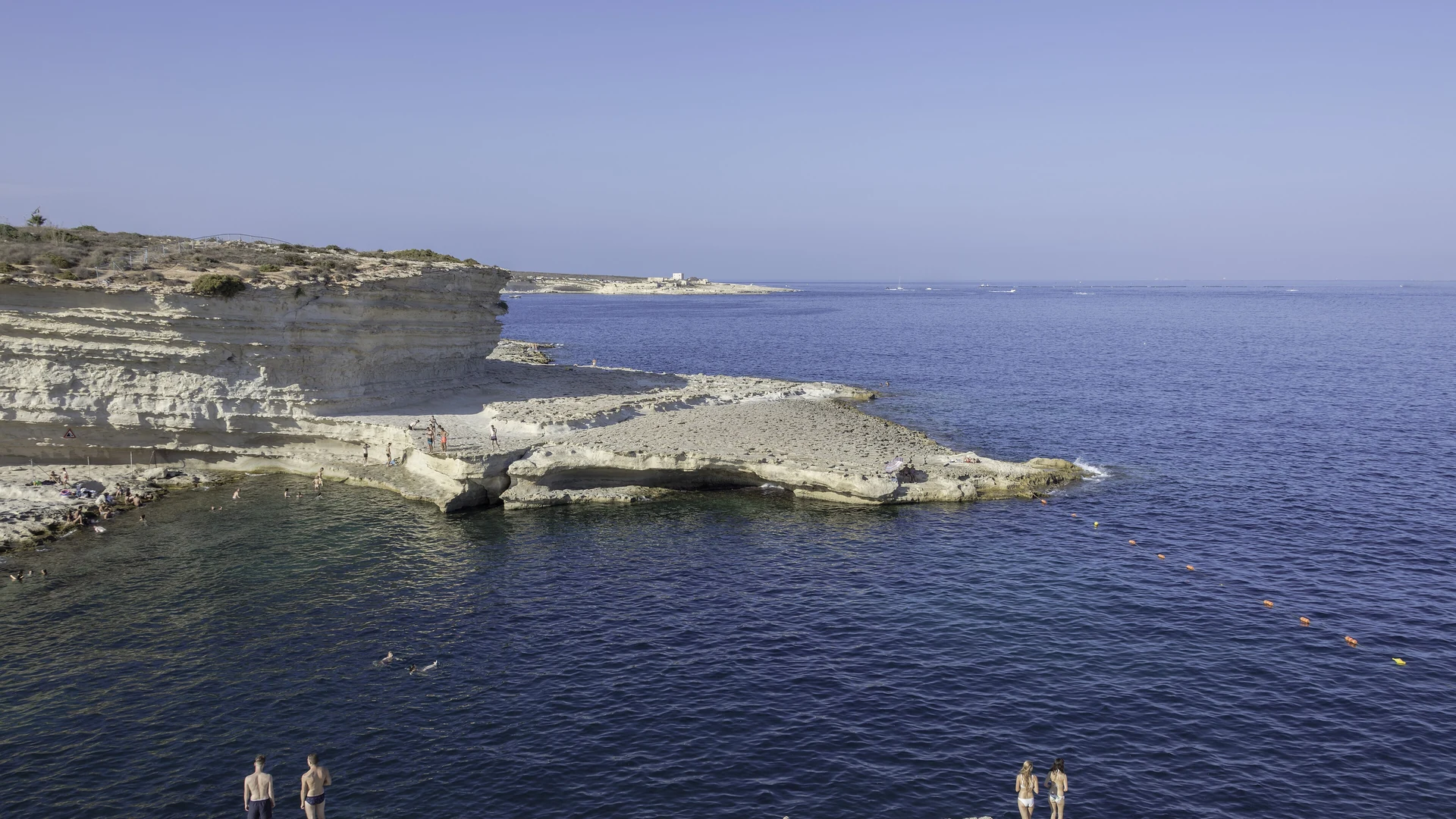
Malta in August runs daytime highs of 31–32°C and night lows of 22–24°C, with the sea at its annual peak of about 26–27°C. That water temperature is the whole case for the month: it is the warmest sea Malta gets, and it is what makes 32°C on an exposed limestone island survivable rather than punishing.
The rain figure is the one most guides get wrong. August is not a zero-rain month – it averages roughly 6–15 mm across about one wet day, negligible in practice but a real distinction from July, which genuinely averages nothing. The other date worth planning around is 15 August, Santa Marija, a national public holiday when seven parishes hold their titular festa simultaneously.
How hot is Malta in August?
Hot, humid, and hottest at the point when most visitors want to be outdoors. The standard long-term averages put August's daytime high at 31–32°C, with the full spread across published sources running from about 30°C to 32.5°C depending on the station and the reference period used.
Overnight lows sit at 22–24°C, and that is the figure that catches people out. August nights do not cool down, so a room without working air conditioning is a bad night's sleep rather than a minor inconvenience.
| July | August | September | |
|---|---|---|---|
| Average day high | 31–32°C | 31–32°C | ~29°C |
| Average night low | 22–24°C | 22–24°C | ~20–21°C |
| Sea temperature | ~25°C | ~26–27°C | ~26°C |
| Rainfall | ~0 mm | ~6–15 mm | ~36–40 mm |
| Wet days | 0 | ~1 | ~4 |
July and August are within half a degree of each other on air temperature, and which one comes out hotter changes with the source. The practical answer is that they are the same month with different water: August's sea is a degree or two warmer, and September's is warmer still than July's. Our Malta temperature by month page sets both against the other ten.
Humidity is the part the number hides. Malta sits in open sea, so August air carries a lot of moisture, and 32°C here feels heavier than 32°C somewhere dry and inland. Valletta and Mdina make it worse again – dense limestone grids with narrow streets that absorb heat all day and release it into the evening.
Does it rain in Malta in August?
Barely, but not never, and the distinction is worth getting right. Sources disagree on the total: Climates to Travel gives August about 15 mm, while Malta's Met Office series and holiday-weather records give closer to 6 mm. Both agree on roughly one wet day across the month.
What that means on the ground is a single short, heavy burst – often a thundery evening late in the month as the first autumn instability arrives – rather than anything that costs you a day. July is the month that is genuinely dry, at effectively 0 mm and no wet days. If you want the driest possible fortnight in Malta, it is early July, not August.
Nobody should plan an August trip around rain. But the difference matters for late-August travellers, because that first thundery day is usually the signal that the summer pattern is breaking.
How warm is the sea in Malta in August, and is it the warmest month?
The sea reaches about 26–27°C in August, its highest point of the year – Climates to Travel records 26.5°C, Weatherspark about 26.1°C, and Seatemperature.org up to 26.9°C in the last week of the month.
August and early September are effectively tied. August edges it on the long-term averages, but by a margin smaller than the difference between two beaches on the same afternoon. Water gains and loses heat far more slowly than air does, which is why the sea keeps climbing through August while the air has already peaked, and why it is still above 20°C in November.
Practically, it means no acclimatisation and no cold shock at any hour – you can swim at 07:00 or at 22:00 and the water feels the same.
It is also the only reliable relief from the middle of the day, which is why August works far better as a boat-and-beach month than a sightseeing one. The best beaches in Malta guide covers where to go, and the Blue Lagoon is at its most beautiful and its most crowded at once.
What is Santa Marija, and why does 15 August matter?
15 August is the Feast of the Assumption – Santa Marija – a national public holiday in Malta, and the single biggest date in the festa calendar. It is not one village's feast. Seven parishes celebrate their titular festa on the same day: Mosta, Mqabba, Qrendi, Attard, Gudja, Għaxaq, and Victoria in Gozo.
That concentration is what makes it different from the ordinary summer festa circuit.
- Mosta – the largest, staged around the Mosta Dome, and the one most visitors end up at
- Mqabba – the fireworks village, and widely held to put on the best aerial display in the country
- Victoria, Gozo – the Gozitan centre of the day, and the reason the ferry queues are worth planning around
- Cost – free to attend in all of them; you pay for transport, food and a bed
- What shuts – banks, offices and many shops close for the public holiday, and bus timetables run to a Sunday pattern
Book accommodation for the week of 15 August earlier than you would for the rest of the month, and expect the roads and the Gozo ferry to be busy in the evening. If a festa is the reason you are coming, aim to be in one village for the night rather than trying to catch two.
Is August too hot to sightsee in Malta?
For the middle of the day, honestly, yes – and the fix is scheduling rather than avoidance. Sightseeing before 11:00 or after 17:00 works; 12:00 to 16:00 in Valletta or Mdina in August does not. The megalithic temples are canopied, which helps, but the walk in from the car park is not.
Evening is where August is at its best, and it is the sensible slot for anything on the water. A sunset run out to Comino gets you the warmest sea of the year and a boat's worth of breeze in the two hours when the land is still radiating heat back at you.
If you can shift your dates at all, best time to visit Malta makes the case for late September – nearly the same sea, several degrees off the air temperature, and a fraction of the prices. Our worst time to visit Malta guide is blunter about where the August peak falls down.
What does August cost, and what should you pack?
August is the most expensive month of the Maltese year, and it is not close – flights, hotels, car hire and the popular boat tours all sit at their annual high, and the Santa Marija week is the peak within the peak. Our is Malta expensive guide sets a realistic daily budget, and the best hotels in Malta list shows where the money actually goes further.
Pack for heat that does not let up overnight.
- Confirmed air conditioning – 22–24°C nights make it the one accommodation feature worth checking before you book
- High-factor sun cream and a hat – the islands are low, treeless and short on shade
- More water than you expect – and a refillable bottle; tap water is safe but heavily desalinated in taste
- Swimwear you can wear all day – the sea is the itinerary, not a break from it
- Something to cover shoulders – churches enforce it, including during festa week
The full things to do in Malta guide has opening hours; check them for August specifically, as several sites shut for the public holiday on the 15th.
Featured image: Diego Delso / Wikimedia Commons / CC BY-SA 4.0