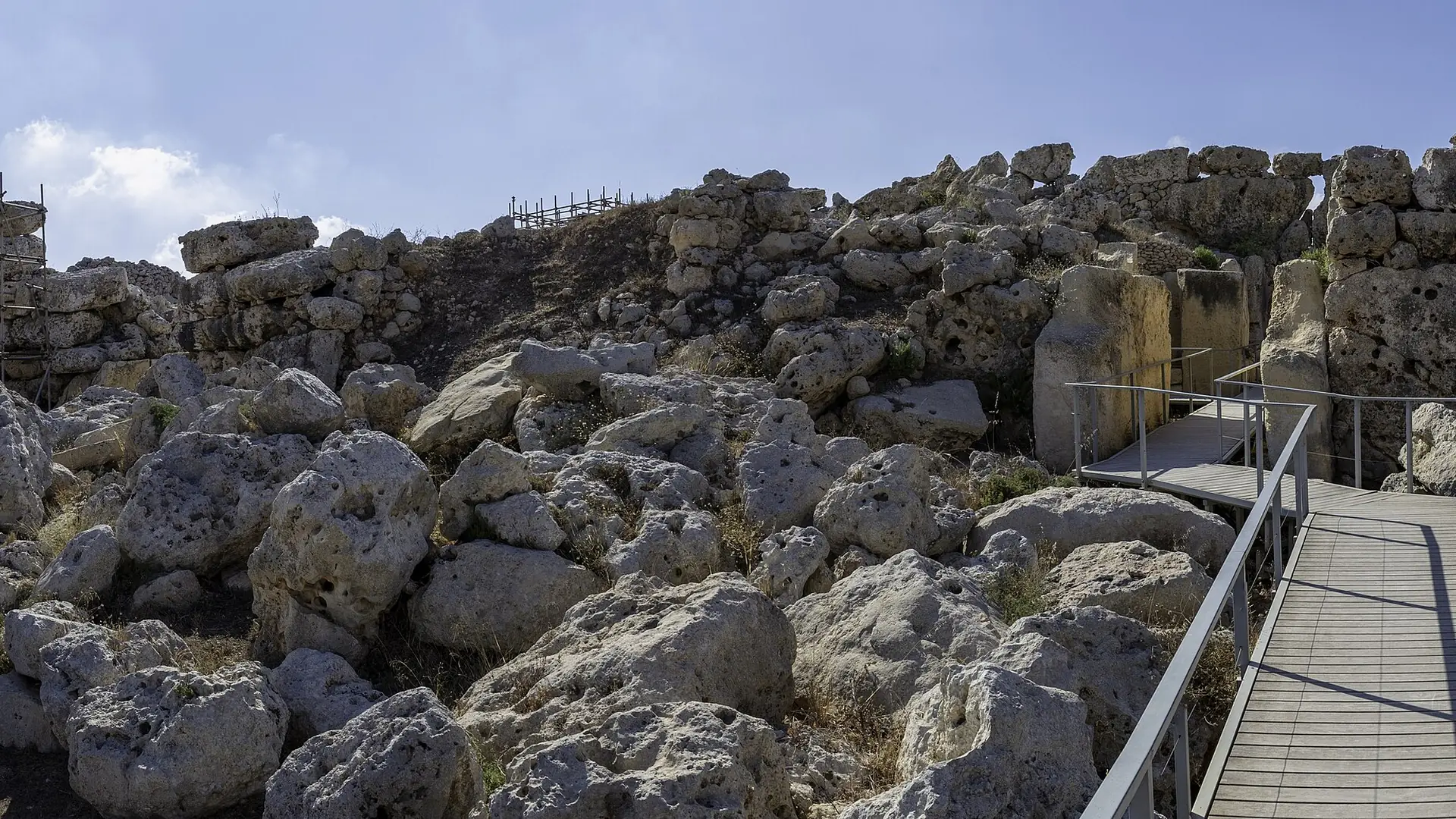
Ġgantija is Gozo's great prehistoric site: two temples standing side by side behind a shared outer wall in the village of Xagħra, built around 3600 BC and among the oldest free-standing stone structures on Earth. Some of the limestone blocks weigh over 50 tonnes, which is what stops most visitors mid-step.
One adult ticket costs €10 and covers both the temples and the Ta' Kola Windmill a few minutes away, and unlike several smaller Heritage Malta sites, Ġgantija opens seven days a week. Allow an hour to an hour and a half including the museum. Below: what the ticket buys, when to come, and how to reach Xagħra from Victoria.
Malta: Full-Day Excursion to Gozo
The version that removes the ferry and the driving from the equation: hotel pickup in Malta, both ferry legs, transport around Gozo, a guide, lunch with a glass of wine and the entrance tickets included. Ġgantija is a standard stop on the route.
- Return ferry, hotel pickup and transport around Gozo
- Guide and all entrance tickets included
- Lunch with a glass of wine
What does it cost, and when is it open?
The Heritage Malta ticket is a combined one: €10 for adults, €8 for youths, seniors and students, €6 for children aged 6–11, and free for infants aged 1–5. It covers the Ġgantija Archaeological Park and the Ta' Kola Windmill in the same village, which is the detail most visitors miss until they are handed the ticket.
- Open: seven days a week, unlike several smaller Heritage Malta sites that run reduced days
- Summer, roughly 1 June to 30 September: 09:00–18:00
- Winter, roughly 1 October to 31 May: 09:00–17:00
- Last admission: 30 minutes before closing, a Heritage Malta rule across all its sites
- Closed: 1 January, Good Friday, and 24, 25 and 31 December
Published hours vary slightly between sources and Heritage Malta does not list them as text on its own site, so a same-day check is worth the thirty seconds in shoulder season.
What is Ġgantija?
The name comes from the Maltese word for giantess. Local legend held that a female giant carried the blocks from the south of Gozo and raised the temples in a single day and night – a story that survived because the stonework genuinely looks impossible without machinery.
The reality is no less striking. Neolithic farmers built this around 5,600 years ago using ramps, rollers and organised labour, a millennium before the Egyptian pyramids, and the method is still not fully understood.
Ġgantija gives its name to the earliest phase of Maltese temple building, the Ġgantija Phase of 3600–3000 BC. These are the oldest temples in the archipelago, predating Tarxien and Ħaġar Qim.
The two temples
The South Temple is the older and better preserved, dating to around 3600 BC. Its curved outer façade still stands several metres high, and inside, five apses open off a central corridor in the standard Maltese plan – with traces of original plaster still visible on some interior walls.
The North Temple was built roughly 600 years later, around 3000 BC. It is smaller and less intact, follows the same apse layout, and shows construction differences that point to a later building tradition.
Both sit behind a single outer enclosure wall, itself a serious piece of engineering, which is why the complex reads as one massive structure from outside.
The visitor centre and museum
All visits start at the visitor centre, where a museum holds finds from Ġgantija and the surrounding area: pottery, figurines, animal bones and carbonised seeds that date the site and show how it was used. One fragment of limestone altar carries pitting that may indicate ritual use of fire.
The displays also place Ġgantija within the wider sequence of Maltese prehistory, which is genuinely useful if you are seeing several temples on one trip. Allow 20 to 30 minutes here before walking out to the stones – our Malta megalithic temples overview covers how the sites relate to one another.
Getting to Ġgantija
From Victoria it is about 10 minutes by car, or bus route 64 towards Xagħra, which stops a short walk from the site. There is parking near the visitor centre.
Gozo's bus frequency thins outside peak hours, so check the timetable for your return before committing to a specific departure. If you are coming from Malta for the day, hiring a car on the Gozo side or taking a guided excursion is usually less friction than assembling bus connections – our Gozo day trip guide covers both ferries and the route that wastes the least time.
Ġgantija or Ħaġar Qim?
If you are seeing both islands, see both – they are different experiences rather than competing ones. If you have time for one, it comes down to where the rest of your trip is.
Ħaġar Qim and Mnajdra sit on a Malta clifftop with sea views and anchor a south coast day. Ġgantija is inland on Gozo, older, and suits a day built around the island's villages and coast. Ġgantija is also the quieter of the two, which matters more than it sounds in July.
One footnote for anyone who follows heritage politics: a residential development inside Ġgantija's UNESCO buffer zone has been permitted, revoked and contested since 2023. It has no effect on visiting, but it is a live argument on the island. If Gozo holds your interest beyond the temples, things to do in Gozo has the rest.
Featured image: Diego Delso / Wikimedia Commons / CC BY-SA 4.0