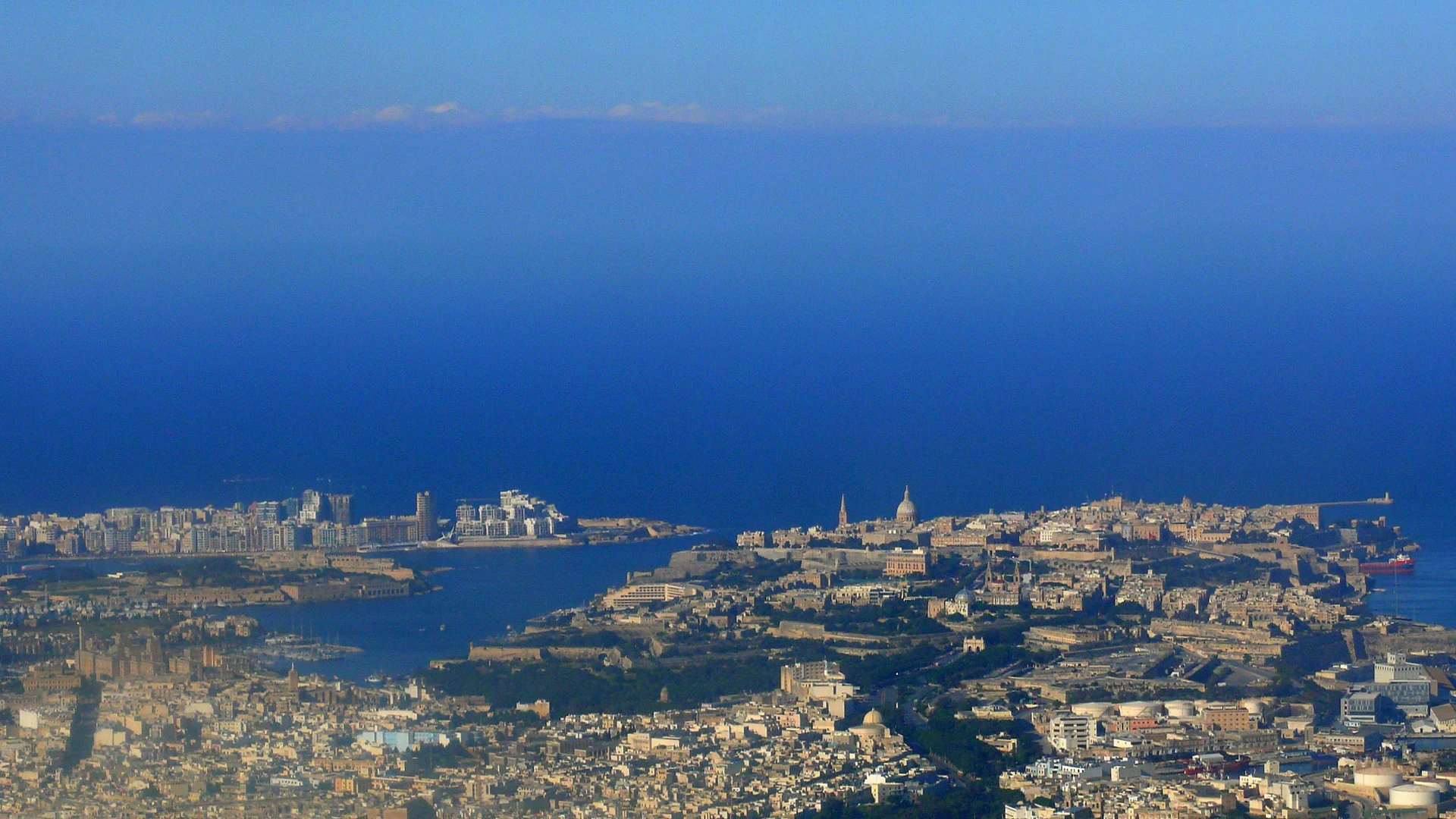
Malta is a small island country in the central Mediterranean Sea, about 80 km south of Sicily and roughly 290 km north of the North African coast. It lies in Europe and is a full EU member, even though it sits closer to Africa than much of mainland Europe does.
The country is an archipelago of three inhabited islands – Malta, Gozo and Comino – with Valletta as its capital. Here is exactly where it sits, what surrounds it, and how to picture it on the map.
Where exactly is Malta?
Malta lies almost precisely in the middle of the Mediterranean, on the line between southern Europe and North Africa. Its coordinates are roughly 35.9°N, 14.4°E – south of Sicily, east of Tunisia and north of Libya.
That position is the key to understanding the place. For thousands of years Malta sat astride the trade and military routes linking Europe, Africa and the Levant, which is why its history runs through the Phoenicians, Romans, Arabs, the Knights of St John, the French and the British in turn.
It is also very small. The whole country covers just over 300 square kilometres, making it one of the smallest states in the world – a dot on a map of the Mediterranean, but a dot in the centre of it.
For scale: you can drive from one end of the main island to the other in about an hour, and the entire archipelago would fit inside the Isle of Wight with room to spare.
Is Malta in Europe or Africa?
Malta is in Europe, both geographically and politically. It is counted as part of the European continent, it is a member state of the European Union, and culturally it leans firmly towards southern Europe and Italy in particular.
The confusion is understandable. Malta sits closer to the North African coast than it does to much of mainland Europe, and the light and the landscape can feel more African than Italian. But by every standard definition – continental, political and cultural – Malta is European.
The geology is genuinely ambiguous, and it is worth being precise about it. Malta sits on the Pelagian Block – a shallow continental platform that is technically part of the African tectonic plate – linked by shallow water to the Hyblean plateau of southeastern Sicily.
That is a geologist's answer rather than a traveller's one. By continental convention, political membership and culture, Malta is European, and it is the only classification that affects a visit:
- EU member: since 1 May 2004
- Currency: the euro, adopted in 2008 – before that, the Maltese lira
- Schengen Area: yes, so no internal border checks from most of the EU
- Driving: on the left, a British inheritance rather than a European norm
Is Malta part of Italy?
No. Malta is an independent country – the Republic of Malta – and has been since gaining independence from Britain in 1964. It is not part of Italy, despite being a short hop from Sicily and sharing deep Italian cultural ties.
Malta was a British colony for over 150 years, which is why English is an official language, cars drive on the left, and British habits run through daily life. Maltese, the other official language, is a Semitic language written in the Latin alphabet – the only one in the world, and a direct descendant of the Arabic spoken here a thousand years ago, layered with Italian and English.
So Italy is the nearest neighbour and a heavy cultural influence, but Malta governs itself and sits as its own member state within the EU.
How far is Malta from Sicily, Italy and beyond?
Sicily is the closest land, around 80 km to the north. That is close enough for a fast catamaran: Virtu Ferries runs the crossing from Valletta to Pozzallo in about 1 hour 45 minutes, with up to three sailings a day each way in the April–October season.
| From Malta to | Distance | Typical journey |
|---|---|---|
| Sicily (Pozzallo) | ~80 km | Ferry, ~1h 45min |
| Catania | ~220 km | Short flight |
| Rome | ~700 km | Flight, ~1.5–2 hours |
| Tunisia (nearest coast) | ~290 km | Short flight |
| London | ~2,100 km | Flight, ~3 hours |
| Istanbul | ~1,800 km | Flight, ~2.5–3 hours |
Most of central and northern Europe is 2.5 to 3 hours away by air. That accessibility is a real part of the appeal: Malta is genuinely in the middle of things, easy as an add-on to an Italian trip or as a standalone short-haul break.
If you are already picturing the trip rather than the map, it is worth browsing what runs on the islands – the Gozo and Comino boat schedules in particular thin out sharply outside the summer season, which shapes when a visit is worth making.
The Maltese islands: Malta, Gozo and Comino
Malta is not one island but a small archipelago, and only three of them are inhabited.
- Malta: much the largest, holding Valletta, the airport, most of the historic sites and the bulk of the population
- Gozo: greener, quieter and more rural, a short ferry ride north
- Comino: barely populated, sitting between the two, famous for the turquoise Blue Lagoon
- Uninhabited islets: Filfla, Cominotto and a few others round out the group
The main island carries the cities and the infrastructure; Gozo is the slower escape. Our Malta vs Gozo comparison weighs up the two, and the Comino guide covers the smallest of the three.
How to get to Malta
For almost every visitor, the answer is to fly. Malta International Airport at Luqa is the country's only airport, well connected across Europe, with flights from Britain taking around three hours. Both low-cost and full-service airlines serve it year-round.
The alternative is the sea. The Virtu Ferries catamaran from Sicily is the practical route if you are combining the two islands, and cruise ships call directly at the Grand Harbour in Valletta.
There are no road or rail links – it is an island, and there is no bridge or tunnel to anywhere. Once you land, the airport sits close to the main resort areas: our Malta airport transfers guide covers the options, and getting around Malta explains the buses, ferries and car hire.
Time zone, language and money
Malta runs on Central European Time (CET/CEST) – the same as Italy and Spain, and one hour ahead of the UK.
- Currency: the euro, with cards accepted almost everywhere
- Official languages: Maltese and English, both with full legal status
- English use: near-universal, including road signs, menus and public services
- Plugs: UK-style three-pin sockets, another British inheritance
That English fluency removes the language barrier that often comes with a Mediterranean trip, and it is one of the practical reasons Malta punches above its size as a destination.
If you are weighing up a visit rather than settling a geography question, our things to do in Malta guide covers what is actually there, best time to visit Malta handles the seasons, and is Malta expensive breaks down the costs.
Featured image: Leslie Vella / Wikimedia Commons / CC BY 2.0