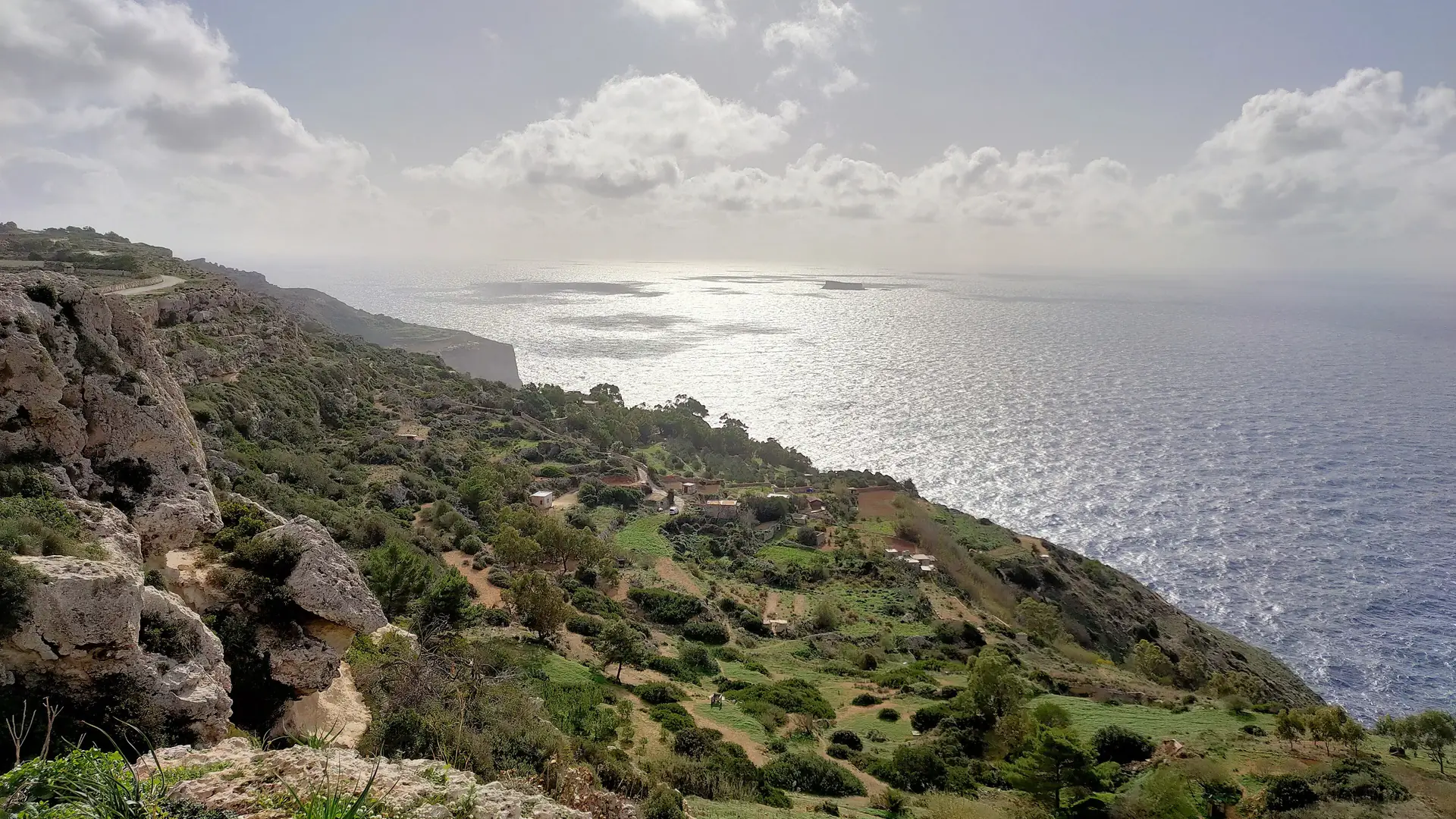
The Dingli Cliffs rise 253 metres above the Mediterranean on Malta's southwest coast, making them the island's highest point by a clear margin, with roughly two kilometres of open limestone plateau running along the top. They face due west, which is the whole point – the sun drops straight into the open sea and there is nothing between you and it.
The mistake almost everyone makes is treating this as a 20-minute stop. Park, look over the parapet, photograph, leave. Done that way the drive out is barely worth it. Done properly – the clifftop walk, the cart ruts at Clapham Junction and the woodland at Buskett – it is one of the better half-days on the island, and it costs nothing. Below: the loop, the timing and how to get there without a car.
What is at the top of the cliffs?
Less than you might expect, which is the appeal. The plateau is open, mostly flat and still farmed, crossed by informal paths that need no map. The main viewpoint has a stone parapet, a café and the full 253-metre drop below it.
The one building is the Chapel of St Mary Magdalene, a small whitewashed church perched on the cliff edge that has become the shorthand image of the whole site. It is usually closed, and it is the thing everyone photographs anyway.
Further along the ridge sits the Dingli Radar, the golf-ball aviation installation visible from much of central Malta. You cannot visit it, but it is a useful landmark, and the path towards it is one of the quieter stretches.
What is there to do at the Dingli Cliffs?
Walk and wait for the light, in that order.
The clifftop path runs north and south from the viewpoint across roughly two kilometres of plateau. It is flat, unmarked and impossible to get lost on. Twenty minutes gets you clear of the car park and the coaches.
Sunset is the reason to time a visit rather than fit one in. The final 45 minutes before the sun goes turns the limestone orange and the water silver. Arrive about 90 minutes before, walk south, then come back to the viewpoint for the last of it.
For a guided version, the Dingli Cliffs sunset Segway tour runs about two hours along the clifftop and is timed for the light. It covers more ground than most people walk on their own and is the practical option if you have not hired a car.
Serious walkers have a different option entirely. The Red Walk coastal trail starts here and runs roughly 14 km south to the Blue Grotto, taking about three hours across some of the least-visited coastline in Malta. Plan transport back before you set off.
How do you turn it into a half-day?
Three sites sit within about ten minutes of the viewpoint, and the loop between them involves no backtracking.
Clapham Junction – officially Misraħ Għar il-Kbir – is the strangest of them. A network of prehistoric cart ruts is cut into the open limestone: dozens of parallel grooves running across the plateau, in places straight over the cliff edge. Nobody is certain what made them or why. Entry is free and 30 minutes covers it properly.
Buskett Gardens is the counterweight. The only substantial woodland on the islands, planted as a hunting ground for the Knights and still shaded by pine, oak and citrus, it adjoins Verdala Palace. On a hot afternoon it is the one place around here with real shade – a picnic stop rather than a sight to tick off.
The order that works: cliffs first for the walk, Clapham Junction next, then Buskett, finishing under the trees before heading back towards Rabat. If you are timing for sunset, run it in reverse and end at the viewpoint.
A hire car makes this loop straightforward. Without one, the cliffs themselves are still easy to reach, but Clapham Junction and Buskett become a long walk in the sun.
Can you swim near the Dingli Cliffs?
Not at the cliffs, and for 2026 not nearby either. The drop from the viewpoint is 253 metres onto rock with no access path, so there is no route down at any point along the plateau.
The usual answer was Għar Lapsi, the sheltered cove about ten minutes south. It is closed for 2026 – January's Storm Harry destroyed the slipway and access ramp, €2 million has been committed to rebuilding it, and no reopening date has been announced. Plenty of older guides still send people there.
Treat the Dingli half-day as a walking and sightseeing trip, and put the swimming somewhere else in the itinerary. Our diving and snorkelling guide covers which shore-entry spots are actually open this year.
Getting to the Dingli Cliffs
By car it is about 30 minutes from Valletta and 20 from Mdina, and parking at the clifftop is free and rarely full outside summer weekends.
By bus, Route 52 from Valletta and Route 201 from Rabat both stop in Dingli village, leaving a 10 to 15 minute walk up to the main viewpoint. Check Tallinja for current times – afternoon services thin out in the shoulder season, which matters if you are staying for sunset and need a way back.
The natural pairing is with the old capital: Mdina and Rabat sit 20 minutes away, and our Mdina and Rabat day trip guide covers that side of the same inland day.
When should you visit?
Spring and autumn are the right seasons – March to June and September to November. The temperature suits walking, the plateau is greener after the winter rain, and the site is far quieter than in midsummer.
In July and August, go early morning or in the 90 minutes before sunset and nothing in between. The plateau is fully exposed with no shade at all, which is why the guided tours run in the evening rather than the afternoon.
Winter is underrated here: January and February are quiet, mild by northern European standards, and the long coastal views are clear on most days. The best time to visit Malta guide has the seasonal breakdown, and things to do in Malta covers how an inland day fits a wider trip.
Featured image: Christian Formosa / Wikimedia Commons / CC BY-SA 4.0