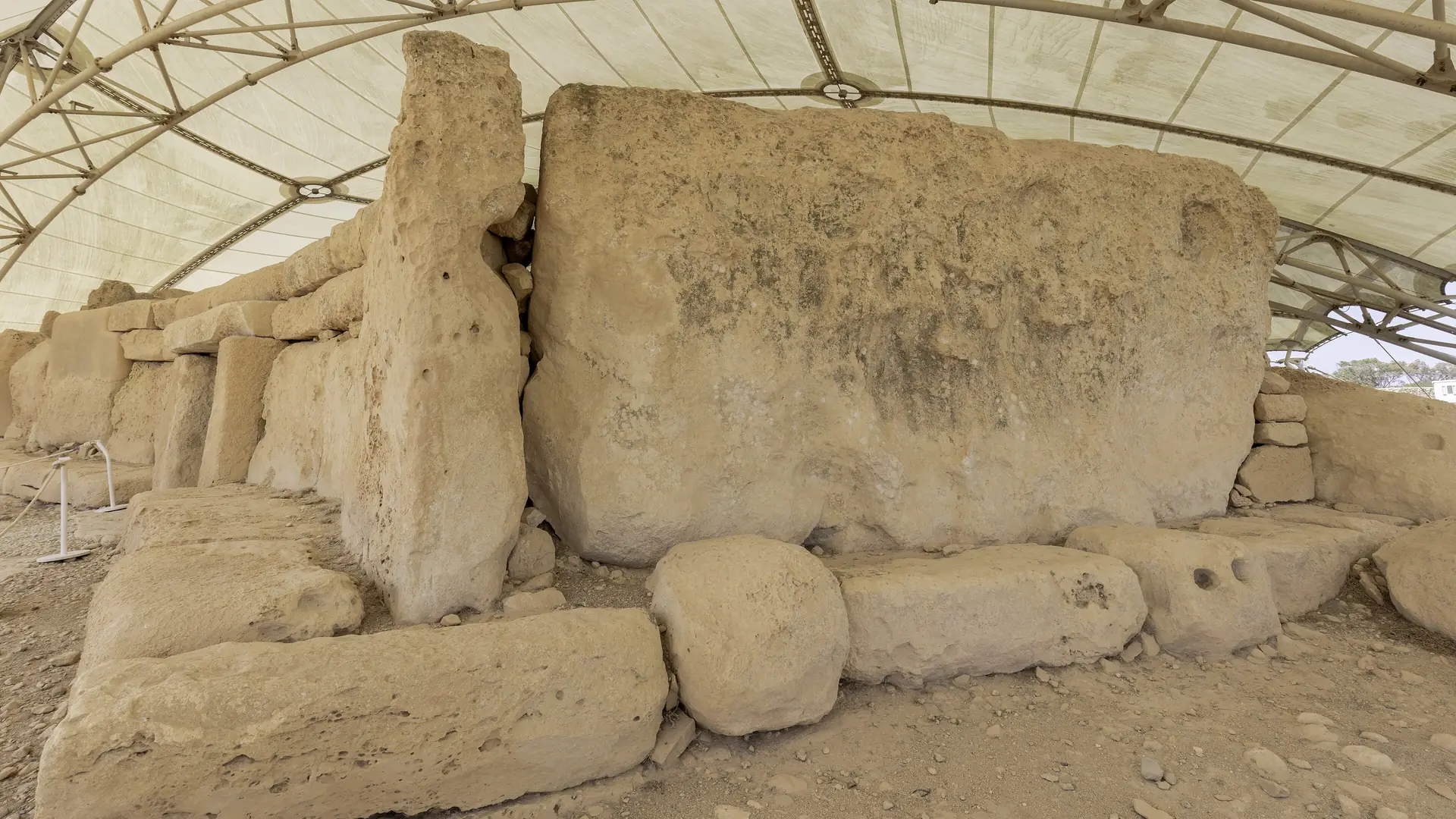
Malta's megalithic temples were raised around 3600 BC, which makes them older than the pyramids of Giza and older than Stonehenge, and seven of them share a single UNESCO World Heritage listing. The above-ground sites need no advance planning at all: Ħaġar Qim and Mnajdra cost €10 on one combined ticket and you can turn up on the day.
The exception is the Ħal Saflieni Hypogeum, an underground burial complex where a strictly limited daily allocation of tickets goes on sale about three months ahead and sells out 2–3 months before the date in summer. That single site decides how early you need to start planning. Below: what each temple costs, and how to get into the one that is hard to get into.
Malta: Prehistoric Temples Tour
Five hours covering the two south-coast temple sites plus the Għar Dalam cave and museum, with hotel pickup and all entrance fees in the price. The practical answer if you are not hiring a car, because linking these sites by bus costs most of a day.
- Ħaġar Qim, Mnajdra and Għar Dalam Cave & Museum
- Hotel pickup and drop-off
- All entrance fees included
What do Malta's megalithic temples cost to visit?
Prices come from Heritage Malta, which runs all four sites. Third-party guides and aggregator sites quote higher figures for several of these temples than Heritage Malta charges – where they disagree, the operator's own price is the one you pay at the desk.
| Site | Adult | Concessions | Child 6–11 | Booking |
|---|---|---|---|---|
| Ħaġar Qim + Mnajdra | €10 combined | €7.50 youth, senior, student | €5.50 | Not needed |
| Ġgantija, Gozo | €10 | €8 youth, senior, student | €6 | Not needed |
| Tarxien Temples | €6 | €4.50 youth, senior, student | €3.00 | Not needed |
| Ħal Saflieni Hypogeum | €35 | €20 youth 12–17 and senior 60+ | €15 | Essential, months ahead |
Infants aged 1–5 go free at the three above-ground sites. At the Hypogeum they are not admitted at all, which is a hard rule rather than a discouragement, and the detail most likely to derail a family's plans.
Which temples are actually worth your time?
Ħaġar Qim and Mnajdra sit a few hundred metres apart on the south-coast cliffs near Qrendi, share one ticket and one visitor centre, and are the pair most visitors should see. Ħaġar Qim is the larger and more immediately impressive; Mnajdra, downhill and closer to the sea, has a temple aligned to sunrise at the equinoxes and solstices. Our Ħaġar Qim and Mnajdra guide covers the site in detail.
They are also 10 minutes from the Blue Grotto, which is why almost every south-coast day combines the two.
Ġgantija near Xagħra on Gozo is older still and comes with the best interpretation centre in the islands. It only makes sense if you are already crossing for a Gozo day trip – the temples are central on the island and add depth to a day that is otherwise beaches and villages.
Allow around two hours for Ħaġar Qim and Mnajdra together including the visitor centre, and about 90 minutes for Ġgantija.
How do you get a Hypogeum ticket?
Book through Heritage Malta and nowhere else. It is the only channel for standard tickets, the painted rock-cut chambers are fragile enough that visitor numbers are capped hard, and no tour operator can conjure a slot at short notice.
- When tickets are released: roughly three months before the date
- Peak season (June–September): expect to book 2–3 months ahead
- Shoulder season: 4–6 weeks is usually enough
- Price: €35 adult, €20 youth 12–17 and seniors 60+, €15 child 6–11
- Not admitted: infants aged 1–5, with no exceptions
What if the Hypogeum is sold out?
There is a back door, and it is worth knowing even though you should not build a trip on it. A very small number of last-minute Hypogeum tickets are released the day before at €50 each, sold in person only – at Fort St Elmo, the Gozo Museum of Archaeology, the National Museum of Archaeology, the Domvs Romana or the Hypogeum itself.
The limit is four tickets per person and ID is required for everyone in the party, so you cannot send one person to queue for a group of strangers. Numbers are small enough that queuing is a gamble rather than a plan.
The better fallback is above ground. The Tarxien Temples are €6, need no booking and rarely reach capacity – a large, intricately carved complex in the same corner of the island, with the finest relief work of any Maltese temple. Heritage Malta has been trimming opening days at its smaller sites, so confirm the current schedule before you set off.
Do you need a tour, or can you drive it?
The temples are scattered: two on the south coast, one on Gozo, one in a suburb south of Valletta. Linking them by bus means changes at Valletta and most of a day in transit, which is the single strongest argument for not doing it that way. Our getting around Malta guide has the network detail.
A hire car is the efficient choice if you want to combine Ħaġar Qim with the Blue Grotto, Marsaxlokk and a swim in one southern loop, and it costs less than two tour tickets on most days.
A guided tour earns its price differently. It handles the pickup, includes the entrance fees, and usually adds the Għar Dalam cave and museum, where the fossil bone deposits give the prehistoric story a beginning. If you are without a car and short on days, that is the version that works.
Neither option gets you into the Hypogeum. That ticket is bought separately, months earlier, whatever else you do.
When is the best time to visit the temples?
The temple plateaus are exposed, with almost no shade once you leave the visitor centres. In July and August that turns a two-hour visit into a genuinely uncomfortable one, so take the first slot of the morning or the last of the afternoon and skip the middle of the day entirely.
Spring and autumn are the most comfortable seasons for these sites, and the equinoxes draw small crowds to Mnajdra for the sunrise alignment. The best time to visit Malta guide covers the wider seasonal trade-offs.
Featured image: Diego Delso / Wikimedia Commons / CC BY-SA 4.0