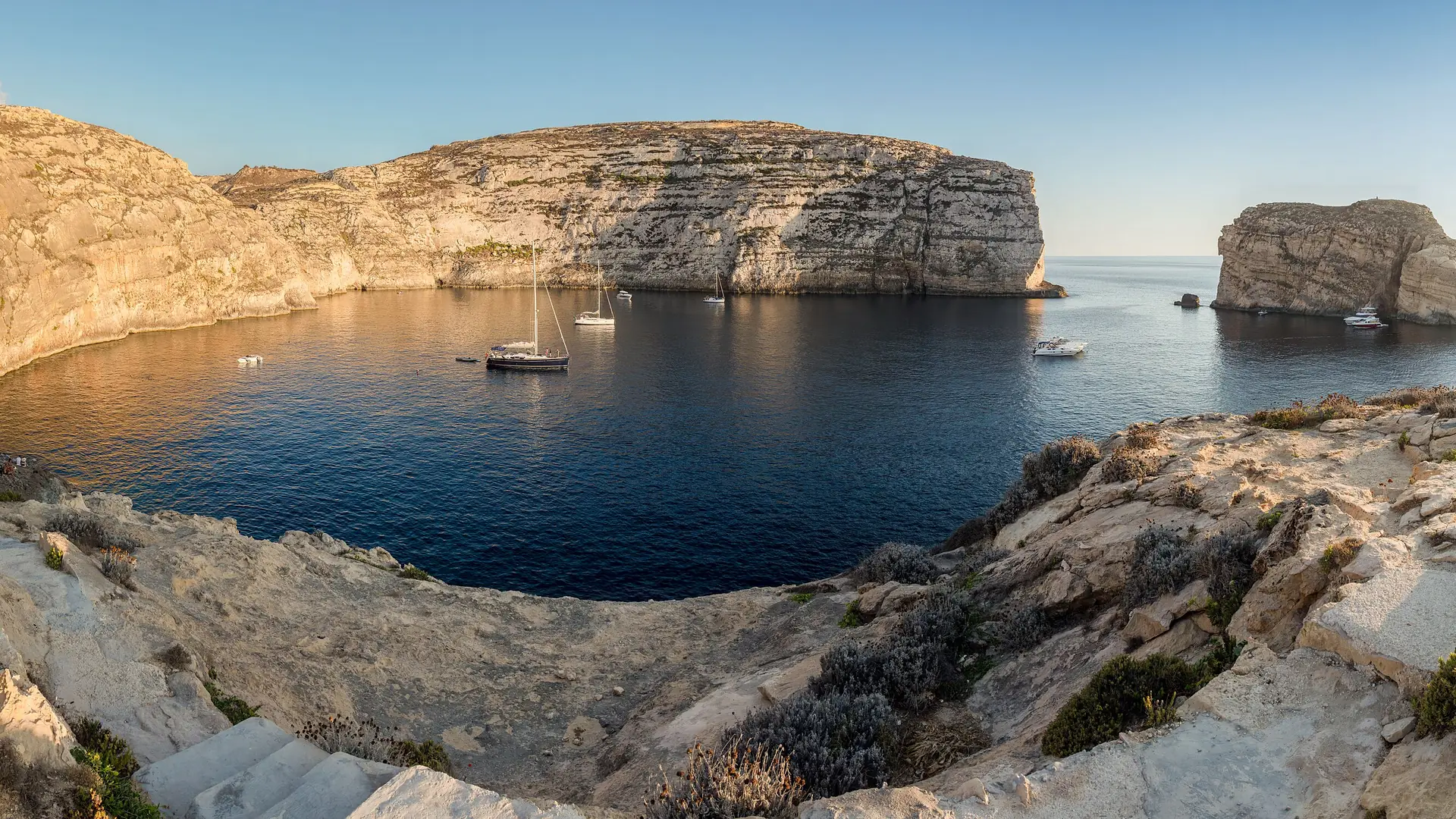
Gozo is 67 km² of Malta's second island, reached by a 25-minute ferry from Ċirkewwa that costs €4.65 for a foot passenger – and you pay for the round trip on the way back, not on the way out. It is greener, slower and emptier than Malta, and everything on it sits within about twenty minutes of everything else.
The sights cluster tightly: Victoria and its hilltop Cittadella in the centre, the Ġgantija temples above Xagħra, the Dwejra coast in the west, and a string of swimming bays around the edges. Below, each of them with 2026 entry prices and the opening days that catch people out – including the museums inside the Cittadella that close on Mondays and Wednesdays while the walls stay open.
How much does the Gozo ferry cost, and how does the fare work?
Two crossings serve Gozo, and they are not interchangeable. The Gozo Channel car ferry from Ċirkewwa to Mġarr runs 24 hours a day – roughly every 30 minutes through the day and every 45 minutes overnight – and takes about 25 minutes.
| Crossing | Adult | Vehicle | Duration |
|---|---|---|---|
| Ċirkewwa – Mġarr car ferry | €4.65 return | €15.70 car with driver | ~25 min |
| Child 3–12 (car ferry) | €1.15 return | – | ~25 min |
| Valletta – Mġarr fast ferry | about €7.50 single | Foot passengers only | ~45 min |
The quirk worth knowing: there is no ticket booth for the outbound leg at Ċirkewwa. You walk or drive straight on, and the whole return fare is collected at the Mġarr terminal on Gozo when you leave. Nothing has gone wrong if nobody asks you for money on the way over – that is how the route has always worked.
The fast passenger ferry from Valletta is the quicker option if you are staying in the harbour area and travelling on foot, though frequency drops outside the summer season. Our Malta airport to Gozo guide compares every route from the moment you land, including the late-night arrivals when only the car ferry is running.
Victoria and the Cittadella: what is free and what is not
Victoria – known locally as Rabat – is Gozo's small capital and its transport hub, so most days on the island begin or pass through here. Above it stands the Cittadella, the fortified citadel that has been the island's refuge since the Bronze Age and its administrative centre under every occupier since.
Walking the Cittadella's fortification walls is free, at any hour, on any day. The circuit takes about twenty minutes and gives a 360-degree view over the whole island – on a clear day as far as Comino and the Maltese coast beyond it.
The museums inside are ticketed, on a Ċittadella Combo Ticket priced between €2.50 and €5, covering the Old Prison, the Archaeology Museum, the Folklore Museum and the Gran Castello complex.
Below the walls, It-Tokk square holds the daily morning market and the cafés that Victoria actually uses. It is a working town rather than a preserved one, and it is the easiest place on the island to eat well cheaply.
Ġgantija: the oldest thing you will see in the Maltese islands
Above the village of Xagħra stand the Ġgantija temples, built around 3600 BC and among the oldest free-standing structures anywhere on earth – older than Stonehenge, older than the Egyptian pyramids, and roughly a thousand years older than either.
Two temples sit side by side behind a shared outer wall, built from coralline limestone blocks that run to more than 50 tonnes apiece. Entry costs €10 for adults, €8 for 12–17s and seniors, and €6 for children aged 6–11, with infants free – and the ticket includes the Ta' Kola Windmill next door, an 18th-century working mill that most visitors walk past without realising they have already paid for it.
Opening hours change three times a year:
- 1 March – 31 October: daily, 10:00–18:00
- 1 November – 4 January: daily, 09:00–17:00
- 5 January – 28 February: 09:00–17:00, closed on Tuesdays
Allow an hour to ninety minutes for the temples, the visitor centre museum and the windmill together. If the prehistory catches you, our megalithic temples guide covers Ħaġar Qim, Mnajdra and the Hypogeum back on the main island. A short walk away, Calypso's Cave looks down over Ramla Bay – the cave itself is closed for safety, but the viewpoint remains one of the best on Gozo.
Dwejra, the Inland Sea and the west coast
The west coast is where Gozo turns dramatic. Dwejra is the stretch where the Azure Window stood until it collapsed into the sea during a storm in March 2017, and the site is still worth the drive without it: the Inland Sea lagoon, the tunnel cut through the cliff, and the dome of Fungus Rock offshore.
Boatmen run the tunnel trip from the Inland Sea out to the open water for about €5 a person, taking roughly 15 minutes each way. It passes through a natural passage barely wide enough for the boat, opening onto the cliffs and caves where the Window used to stand.
It runs only when the sea is calm enough – on a rough day the boats stay on the shingle and no amount of asking changes it.
Dwejra is also one of Malta's headline dive sites, with the Blue Hole – a natural chimney in the rock connecting to the open sea – drawing divers year-round. Sunset here is the one to plan the day around.
Further along the north coast, Wied il-Mielaħ has a natural arch of its own with a fraction of the visitors, and Wied il-Għasri is a narrow cove squeezed between high cliffs, reached down a flight of steps – a swim rather than a beach, and the closest Gozo gets to somewhere secret.
Where to swim on Gozo
Gozo's beaches are smaller than Malta's and considerably better for it. There are four you would plan a day around and several you would stop at on the way past.
- Ramla Bay – the famous one, a wide stretch of red-gold sand under the Calypso viewpoint, and the best swim on the island
- San Blas Bay – a smaller red-sand cove reached by a steep walk down, which keeps the numbers low
- Hondoq ir-Rummien – clear shallow water looking across at Comino, better for snorkelling than sunbathing
- Mġarr ix-Xini – a secluded inlet at the end of a narrow valley, with a single seasonal restaurant and deep clear water
- Xlendi and Marsalforn – rock platforms and lidos rather than sand, right beside the village restaurants
Our best beaches in Gozo guide ranks them properly and covers the access, parking and which ones have facilities. The short version: Ramla for a full beach day, San Blas or Mġarr ix-Xini when you want fewer people, Hondoq for a mask and snorkel.
Xlendi, Marsalforn and the salt pans
Two old fishing villages anchor the coast and both make good evening bases. Xlendi sits at the end of a narrow valley around a small bay, with a seafront of restaurants and a cliff path out to a 17th-century watchtower. Marsalforn, on the north coast, is the larger of the two and Gozo's main seaside resort, busier in August and quiet the rest of the year.
Between them lie the Xwejni salt pans – a chequerboard of shallow rectangles cut into the coastal rock, worked by the same families for generations and still harvested by hand each summer. They are among the most photographed sights on the island, free to walk among, and best in the hour before sunset when the light gets low across the water.
Diving, boats and what is under the water
Gozo is widely rated the best diving in the Maltese islands, and it is the reason a substantial share of the island's visitors come at all. Caves, reefs, wrecks and the Blue Hole at Dwejra draw divers year-round, with visibility that regularly runs past 30 metres. Our diving and snorkelling guide covers the sites, the schools and what certification you need for which dive.
You do not need a tank to get the benefit. The bays are clear enough that a mask and snorkel show you most of what makes the coast worth the trip, and Hondoq, Mġarr ix-Xini and Dwejra are all good from the shore.
For something faster, a Gozo quad or jeep tour links the spread-out coastal sights in half a day and reaches a few tracks a hire car will not. And Comino's Blue Lagoon sits between the two islands, reachable by boat from Mġarr as easily as from Malta – which makes it a natural add-on to a Gozo stay rather than a separate expedition.
How do you get around Gozo?
Nothing on Gozo is more than about 20 minutes from anything else by car, which sounds like it makes transport a non-issue. It does not, quite – the island's buses are cheap and cover the main villages, but they run infrequently enough that a day built around them loses hours to waiting at stops in Victoria.
The practical options, in order of how most visitors use them:
- Hire car – the most freedom, and the ferry crossing costs €15.70 with driver. Worth it for two days or more
- Organised tour – a full-day Gozo excursion handles the ferry, the driving and the route in one booking
- Taxi or jeep from Mġarr – picks you up off the ferry, sensible for a single day without a car
- Bus – €2 in winter, €2.50 in summer, everything routes through Victoria, and the timetable rules the day
If you are staying on Gozo rather than day-tripping, walking and the occasional taxi covers most of it. If you are coming for one day, book the transport before you cross – working it out at Mġarr terminal with the clock running is the fastest way to lose a morning.
Day trip or overnight: how long do you need on Gozo?
One day covers the headlines: the Cittadella, Ġgantija, Dwejra and a swim, in that order, with lunch in Victoria or Xlendi. It is a real day out rather than a rushed one, and our Gozo day trip guide has the ferry timings and the route. Most visitors to Malta do exactly this and leave satisfied.
Two nights is when Gozo becomes a different place. The last day boats leave around dinner time and the island empties – the villages fill with people who live there, Dwejra at sunset belongs to about six people, and the pace drops to something no day trip can show you.
If the quiet is what drew you to Gozo in the first place, a day trip is the one version that will not deliver it.
Where you sleep matters less than that you do: our where to stay in Gozo guide compares Victoria, the coastal villages and the farmhouse conversions inland. Both our 5-day and 7-day Malta itineraries build Gozo in as its own block rather than an afternoon.
Still weighing the two islands against each other? Our Malta vs Gozo comparison sets them side by side, things to do in Malta covers the main island in the same detail, and you can browse Gozo's tours and tickets if you would rather have the logistics handled before you cross.
Featured image: Diego Delso / Wikimedia Commons / CC BY-SA 4.0