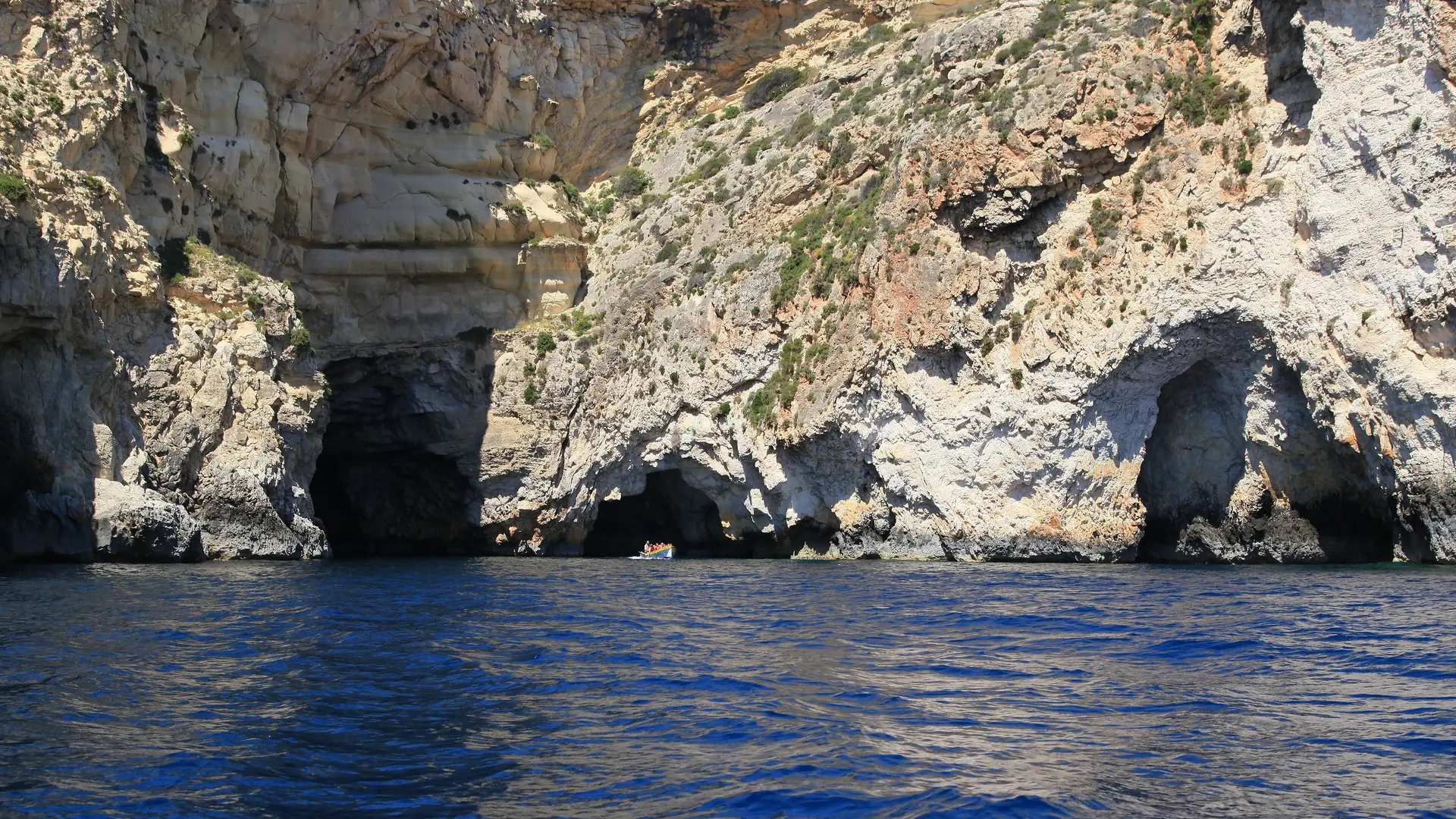
The Blue Grotto is a cluster of sea caves and a natural limestone arch on Malta's south coast at Wied iż-Żurrieq, and it works on exactly two conditions: flat sea and morning sun. The boat into the caves costs €10–12 for adults and about €5 for children, runs roughly 25 minutes, and is cash only at the kiosk – no advance booking, because nobody can promise you the weather.
Come between 09:00 and noon on a calm, sunny day and the water glows the colour the photographs promise. Arrive at 15:00, or on a windy morning, and you get a grey inlet and a jetty with no boats on it. Below: what each way of seeing it costs, how to time the visit, and how to build a south-coast day around it so a cancelled boat does not waste the trip.
From Sliema: Blue Grotto Excursion & Sea Caves Boat Tour
The whole logistics problem solved from Sliema – transport down to the south coast, the sea-caves boat, a scenic clifftop walk and free time to swim. Worth it if you have no hire car and would rather not spend two hours on buses each way.
- Return transport from Sliema – no bus changes to work out
- The sea-caves boat trip into the grotto included
- Scenic coastal walk plus free time to swim
Do you need to book the Blue Grotto, and what does it cost?
There is nothing to book for the site itself. The clifftop viewpoint is free and open at all hours, and the local boats work on a turn-up-and-go basis from the jetty at Wied iż-Żurrieq.
| How you see it | Price | How long | Booking |
|---|---|---|---|
| Clifftop viewpoint | Free | 10 minutes | None – open at all times |
| Local boat from the jetty | €10–12 adult, about €5 child | ~25 minutes | None – cash at the kiosk |
| Guided tour from a resort town | From about €35 | Around 5 hours | Book online in advance |
Bring cash. The kiosk by the jetty does not take cards, and there is no cash machine at the bottom of the valley – a small detail that sends a surprising number of people back up the hill.
The one thing you cannot buy is certainty. The boats only sail when the sea is calm enough to enter the caves, so a windy morning cancels them outright with no notice and no refund process to worry about, because you pay on the spot.
When is the best time to visit the Blue Grotto?
Between 09:00 and noon, on a calm and sunny day. That window is not a preference, it is how the effect works: sunlight enters the caves at a low angle, hits the white sandy seabed and reflects back up through the water as an intense blue. By mid-afternoon the sun has moved and the colour flattens out to ordinary sea.
Early also buys you the calmest water of the day and gets you in ahead of the coach parties, which build from late morning.
- Best hours: 09:00–noon, in clear weather
- Worst hours: mid-afternoon onwards, when the light has gone off the water
- Best seasons: spring and autumn, for the most settled seas and comfortable walking temperatures
- Winter: boats still run year-round, but rough seas cancel them far more often
Season matters less here than the individual day. Check the wind forecast the night before rather than the month in the calendar – our best time to visit Malta guide covers the wider seasonal picture.
What is the boat trip actually like?
Small open wooden boats, roughly eight passengers, an outboard motor and a skipper who has done the route several thousand times. The trip runs about 25 minutes and threads through several caves along this stretch of coast, not just the one big arch the photographs always show.
Inside the caverns the water turns luminous blue and green, and in the larger chambers you can see straight down to the bottom. The colour changes cave to cave depending on how the light gets in, which is the part that surprises people who came expecting one photo stop.
It is a low-key, slightly ramshackle operation with no commentary and no frills, and it is better for it. What it is not is a long excursion – 25 minutes is 25 minutes, so treat it as one stop in a day rather than the day itself.
Is the free clifftop viewpoint worth stopping for?
Yes, and it takes ten minutes. There is a pull-in and a low wall on the road down to Wied iż-Żurrieq, looking across at the main arch – the classic postcard angle, and the one shot you cannot get from a boat, because from the water you are underneath it.
It is also the fallback. On a windy day when the boats are not running, the viewpoint is the only way to see the grotto, and it still justifies the drive if you are already touring the south. Come in the morning here too: the light is doing the same job on the arch as it does inside the caves.
Do both if the sea allows. The high view of the arch and the view from inside the caves are different enough that neither replaces the other.
How do you get to the Blue Grotto from Sliema or Valletta?
By hire car it is roughly 30 minutes from Valletta, and driving is the option that makes the rest of the south coast reachable in the same day. Parking sits above the jetty at Wied iż-Żurrieq.
By bus it is doable but slow: routes reach Wied iż-Żurrieq from the resort areas with a change, and the journey eats a good part of the morning in each direction – exactly the hours when the light is best. Our getting around Malta guide has the network and the fares.
If you are based in Sliema or St Julian's without a car, an organised tour is usually the better value once you count the bus time, because it handles the transport, the boat and the coastal walk in one half-day. If you would rather drive the south yourself, it is worth comparing hire car rates – a car turns three separate outings into one loop.
What to combine with the Blue Grotto on Malta's south coast
The grotto is a short stop, so the day is built from what sits around it. Everything below is within about 20 minutes' drive.
- Ħaġar Qim and Mnajdra temples – prehistoric temples on the cliffs just up the road, on a combined ticket of about €10
- Marsaxlokk – the fishing harbour with the painted luzzu boats, best at Sunday's fish market and good for lunch
- St Peter's Pool – a natural rock swimming pool past Marsaxlokk, and the swim stop that finishes the loop
The sensible order is grotto first for the light, temples mid-morning, then east to Marsaxlokk for lunch and a swim. The Blue Grotto is a Special Area of Conservation with seasonal navigation and anchoring rules from March to October protecting breeding seabirds, which changes how boats route around the coast but not your access to the site.
Is the Blue Grotto worth it?
On the right morning, comfortably. €10–12 for 25 minutes inside genuinely luminous sea caves is one of the better-value things you can do in Malta, and the arch from the clifftop is worth the stop on its own.
On the wrong morning, it is a car park above a grey inlet. That is the honest verdict, and it is why the timing advice matters more here than at any other Maltese sight – this is one of the few places where the weather does not just affect the experience, it decides whether the experience happens.
Judge it as a 45-minute stop in a full south-coast day and it earns its place. Judge it as a destination worth a dedicated cross-island trip on its own and the weather will sometimes disappoint you.
Featured image: Frank Vincentz / Wikimedia Commons / CC BY-SA 3.0