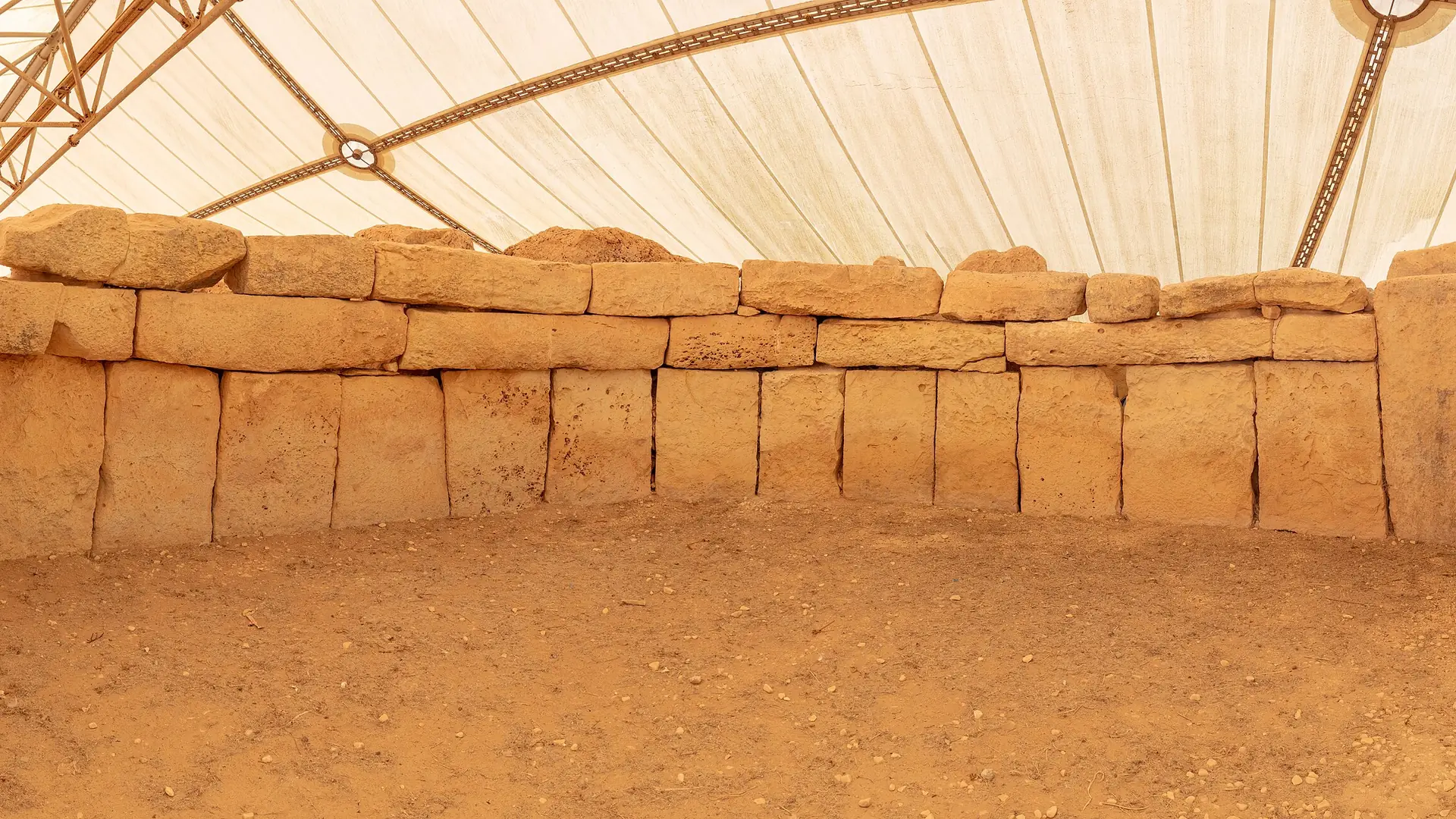
Ħaġar Qim and Mnajdra are two prehistoric temples on a clifftop in southern Malta, raised around 3600 BC – older than the pyramids and Stonehenge. They sit 500 metres apart on the same headland and share a single €10 adult ticket, which makes seeing both the obvious play rather than a decision.
Allow two to three hours, and go on the first slot of the morning in summer. The plateau is exposed and there is almost no shade once you leave the visitor centre. Below: what the ticket covers, how to reach the site by bus or car, which parts are wheelchair accessible, and whether the guided tour earns its price.
Malta: Prehistoric Temples Tour
Five hours covering Ħaġar Qim, Mnajdra and the Għar Dalam cave and museum, with hotel pickup and all entrance fees included. The practical option if you are not hiring a car, since bus route 74 is thin and the return timing is the part that catches people out.
- Ħaġar Qim, Mnajdra and Għar Dalam Cave & Museum
- Hotel pickup and drop-off
- All entrance fees included
What does it cost, and when is it open?
One Heritage Malta ticket covers both temples and the visitor centre: €10 for adults, €7.50 for youths, students and seniors, €5.50 for children aged 6–11, and free for infants aged 1–5. There is no separate Mnajdra ticket and no need to book ahead – this is a turn-up site, unlike the Hypogeum.
Hours are the one thing worth checking on the day. Published guides put the site at 09:00–18:00 in summer and 09:00–17:00 in winter, with last admission 30 minutes before closing. Heritage Malta's own page does not list them inline, so in shoulder season a same-day check is sensible rather than optional.
- Accessible: the visitor centre and Ħaġar Qim itself
- Not accessible: Mnajdra, reached by an uneven downhill path
- Free parking: directly at the visitor centre entrance
- No shade: on either temple site once past the centre
What you are visiting: two temples, one ticket
Ħaġar Qim is the larger and better-preserved, with massive limestone slabs still standing where they were placed. The largest single stone on the site weighs around 20 tonnes. Inside, several apse chambers open off a central corridor – look for the perforated stone screens that once divided the interior, and the shallow niches that likely held offerings.
A figurine known as the "Venus of Malta" was found here. The original is in the National Museum of Archaeology in Valletta; a replica is displayed on site.
Both temples sit under tensile canopies erected in the late 1990s to protect the limestone from acid rain. You see the stones shaded rather than under open sky, which changes the photographs, but the weathering they have prevented is the trade.
The visitor centre
Worth the time before you walk out to the stones. It houses a 4D film introduction to the temple culture, a hands-on room showing how blocks of this size were moved, and a free audio guide downloadable by QR code at the information desk.
The audio guide runs commentary at numbered points across both sites in several languages. For a self-guided visit it does most of the work a tour guide would – the stones are far easier to read with some sense of what the spaces were for.
Mnajdra and the equinox sunrise
The path from Ħaġar Qim drops 500 metres along the clifftop, about 10 minutes on foot, with views out to Filfla – a small uninhabited island two kilometres offshore, used as a bombing target by the RAF during the Second World War.
Mnajdra is three temples built together across different periods, the oldest around 3600 BC and the most recent around 3000 BC. The smallest, southernmost temple is astronomically aligned: at the equinoxes the sunrise lines up precisely with its main doorway and illuminates the central passage.
Heritage Malta runs a dawn equinox event for anyone who wants to see it, priced at €35 per person in 2026, with a gathering time of roughly 05:30–06:00 at the visitor centre. That is up from €25–30 in previous years, so budget for the current figure rather than an older listing.
The setting at Mnajdra is arguably the better of the two – lower on the cliff, closer to the sea and quieter, particularly in the first hour after opening.
How do you get to Ħaġar Qim from Valletta?
By bus, take route 74 from Valletta bus terminus (stop A5) and alight at "Hagar, Il-Qrendi" – about 40 minutes. The service is not frequent, so check the Malta Public Transport app before you go and identify your return departure before you leave, not after you arrive. Missing the last one means a taxi from Qrendi.
By car it is around 25 minutes from Valletta via the coastal road, with free parking at the visitor centre. That is the more practical choice if you want to combine the temples with other southern sights in one loop.
Is a guided tour worth it?
For most independent travellers, no. The free audio guide plus half an hour in the visitor centre covers the essentials well, and the site is small enough that you will not get lost or miss anything significant.
A tour earns its price on transport rather than commentary. The five-hour circuit bundles Ħaġar Qim, Mnajdra and the Għar Dalam cave and museum with hotel pickup and entrance fees, which solves the bus problem in one purchase – and the bus problem is the real friction here, not the interpretation.
If you are driving, skip the tour and build your own southern day. The Blue Grotto is 10 minutes away and best before noon, and Marsaxlokk with its Sunday fish market is 20 minutes in the other direction.
Ħaġar Qim or Ġgantija?
Both are UNESCO-listed and broadly similar in age, but they suit different trips rather than competing. Ħaġar Qim and Mnajdra are on Malta's main island and pair naturally with the south coast. Ġgantija is on Gozo, so seeing it means the ferry – more commitment, but easy to fold into a Gozo day trip.
If you are only on Malta, this is the right choice and there is no need to agonise. Our Malta megalithic temples overview covers every site including the Hypogeum, which is booked separately and months ahead.
Featured image: Diego Delso / Wikimedia Commons / CC BY-SA 4.0