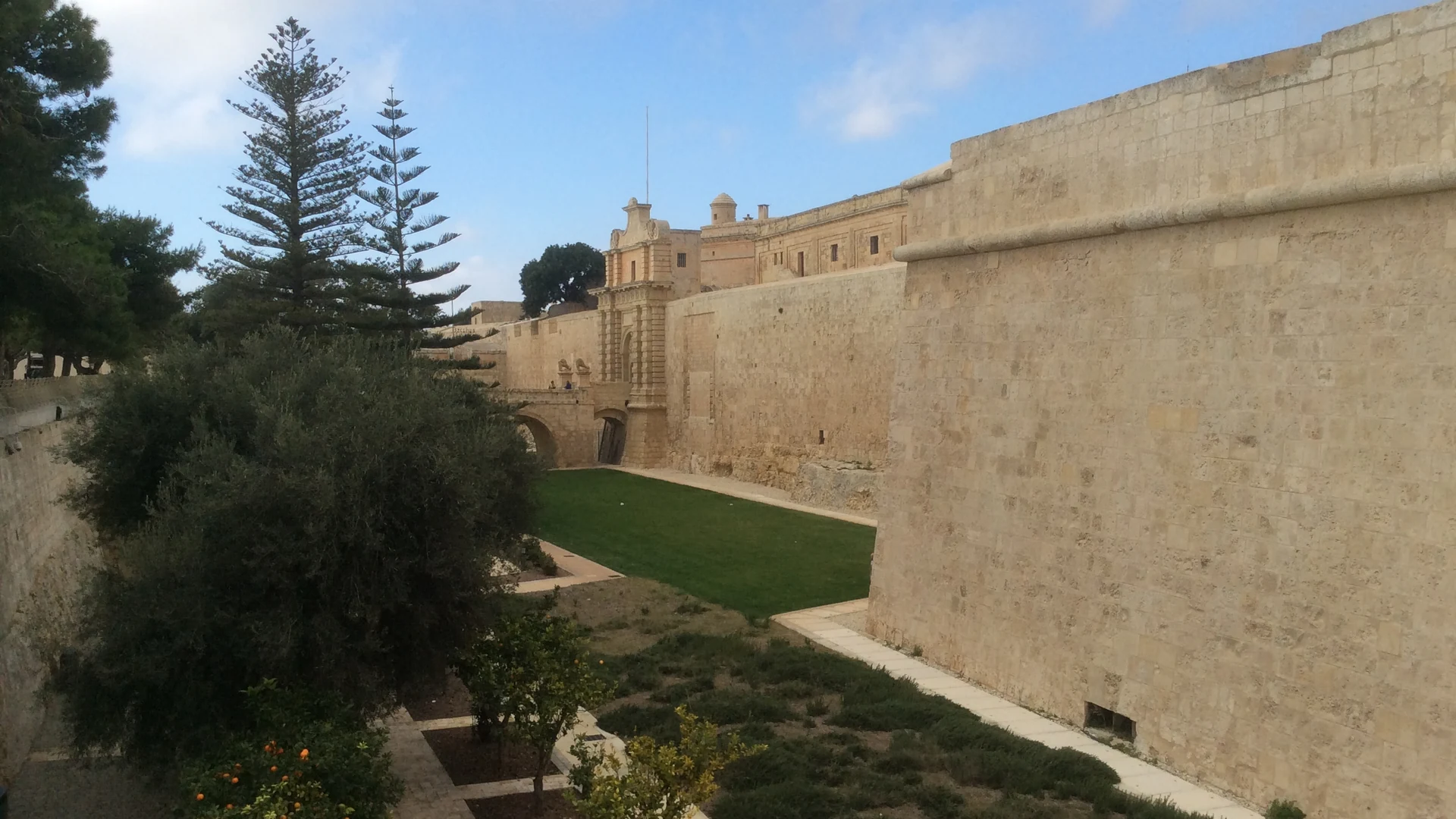
Mdina and Rabat sit on the same hilltop and split the work between them. Mdina is the walled, almost car-free old capital you come to walk, and Rabat, immediately outside the gate, holds the underground half – catacombs, a grotto and Roman remains. Together they make a half-day rather than a full one.
Walking Mdina costs nothing. What you pay for is the interiors, and two matter most: St Paul's Cathedral at €15 for adults, and St Paul's Catacombs in Rabat at €6. Buses 50, 51, 52 and 53 run from Valletta to Rabat in around 30 minutes on a clear road. Below: what each stop costs, when it opens, and the order that works.
Malta: Mdina and Rabat Walking Tour with Catacombs
Two and a half hours on foot through both towns with a guide, and the Rabat entrance tickets bundled into the price rather than bought one by one at four separate desks. The sensible choice on a first visit, when the underground sites need context to make sense.
- Wignacourt Museum, St Paul's Grotto, catacombs and WWII shelters included
- Guide throughout both Mdina and Rabat
- Free cancellation up to 24 hours before
What does a Mdina and Rabat day trip cost?
Entry to Mdina itself is free and always has been – the gate, the lanes and the bastion viewpoint cost nothing at any hour. Everything below is optional, and most visitors pay for one or two of them rather than all five.
| Where | Adult | Concessions | Opening hours |
|---|---|---|---|
| Mdina streets and bastion view | Free | Free | Open at all hours |
| St Paul's Cathedral + Cathedral Museum | €15 | €10 senior 60+ and student, under 12 free | Mon–Sat 09:30–16:30, last ticket 16:15 |
| St Paul's Catacombs, Rabat | €6 | €4.50 youth 12–17, senior and student; €3.50 child 6–11 | Daily 09:00–19:00 (1 Mar–31 Oct) |
| Wignacourt Museum, with St Paul's Grotto | €6 | €4.50 concessions, €3.50 child 7–11 | Daily 09:30–17:00, last entry 16:00 |
| Domus Romana | €6 | €4.50 concessions, €3.00 child 6–11 | Reduced days – check before travelling |
Two people doing the cathedral and the catacombs will spend €42, which is the realistic mid-range version of this trip. Skip the cathedral and the same day costs €12.
How do you get from Valletta to Mdina?
Routes 50, 51, 52 and 53 run from the Valletta bus terminus to Rabat, and route 56 covers the same corridor. There is no change and no interchange to work out – it is one bus, and it is the standard way locals do it too.
- Timetabled journey: around 30 minutes from Valletta
- In practice: allow 45–60 minutes in peak summer traffic, which the timetable does not price in
- Where you get off: the Rabat terminus, roughly a five-minute walk from Mdina Gate
- From Sliema or St Julian's: expect a change, so budget closer to an hour each way
- Live times: the Tallinja app, which reflects diversions the printed timetable does not
Coming from the northern resorts, the maths changes. Our getting around Malta guide covers the network and fares, but the short version is that a hire car turns Mdina into one stop of a wider inland day rather than the whole outing.
What is there to see inside Mdina?
The walking is the attraction. Roughly 300 people still live inside the walls and general traffic is kept out, which is why the "silent city" name has stuck to a place that gets several thousand day visitors. An unhurried loop of the lanes takes 45 minutes to an hour.
St Paul's Cathedral is the one interior worth the ticket, and the €15 is a combo covering the Cathedral and the Cathedral Museum a few metres away, where the tickets are actually sold. Allow 20 to 30 minutes for the cathedral and another 30 if the museum's Dürer woodcuts interest you.
The bastion viewpoint at the northern edge is free and looks out across central Malta to the sea. It takes five minutes and it is the shot most people came for.
What is worth seeing in Rabat?
St Paul's Catacombs are the most distinctive thing you will see all day: an early-Christian burial complex of interconnected rock-cut tombs that you walk down into, run by Heritage Malta and open daily from 09:00 to 19:00 through the summer season, with last admission 30 minutes before closing.
They are enclosed, low in places and reached by steps, so they are a poor fit for anyone uneasy in tight underground spaces. There is no way to see the site from above.
A separate set of catacombs sits beneath the Wignacourt Museum, and the two are easy to confuse. The Wignacourt ticket is €6 and covers the museum, St Paul's Grotto, its own catacombs and a fifty-room complex of WWII shelters – which makes it the better-value single ticket of the two, and the one guided tours use.
The Domus Romana, a Roman townhouse with surviving mosaics, is €6 and worth 30 minutes if you like that period. Heritage Malta has cut back opening days at several of its smaller sites, so check the Domus Romana is open on your date rather than turning up on the strength of an older guide.
What order should you do it in?
Start in Mdina and finish in Rabat. The ticketed sites in Rabat close earlier in the afternoon than Mdina's streets do, and Mdina is the part that keeps working after dark.
- 10:00 – through Mdina Gate, slow loop of the lanes, bastion view
- 11:00 – St Paul's Cathedral and, if you want it, the Cathedral Museum
- 12:15 – pastizzi and coffee in Rabat's main square, about €1 each
- 13:00 – St Paul's Catacombs, or the Wignacourt Museum complex if you would rather have the grotto and shelters
- 14:30 – Domus Romana, or the bus back
That is four to five hours door to door from Valletta, which leaves the rest of the day free. It slots neatly into a 3-day Malta itinerary as the inland half of a day, and pairs naturally with Mosta and its dome a short drive away.
Should you take a guided tour or go on your own?
The honest answer is that the towns reward both approaches, because they are asking different things of you. Mdina is a place you look at and Rabat is a place that needs telling.
If you are building a wider trip, this pairs well with a day in Valletta for the contrast between Malta's old capital and its current one, and our things to do in Malta guide has the rest of the shortlist.
Featured image: Continentaleurope / Wikimedia Commons / CC BY-SA 3.0