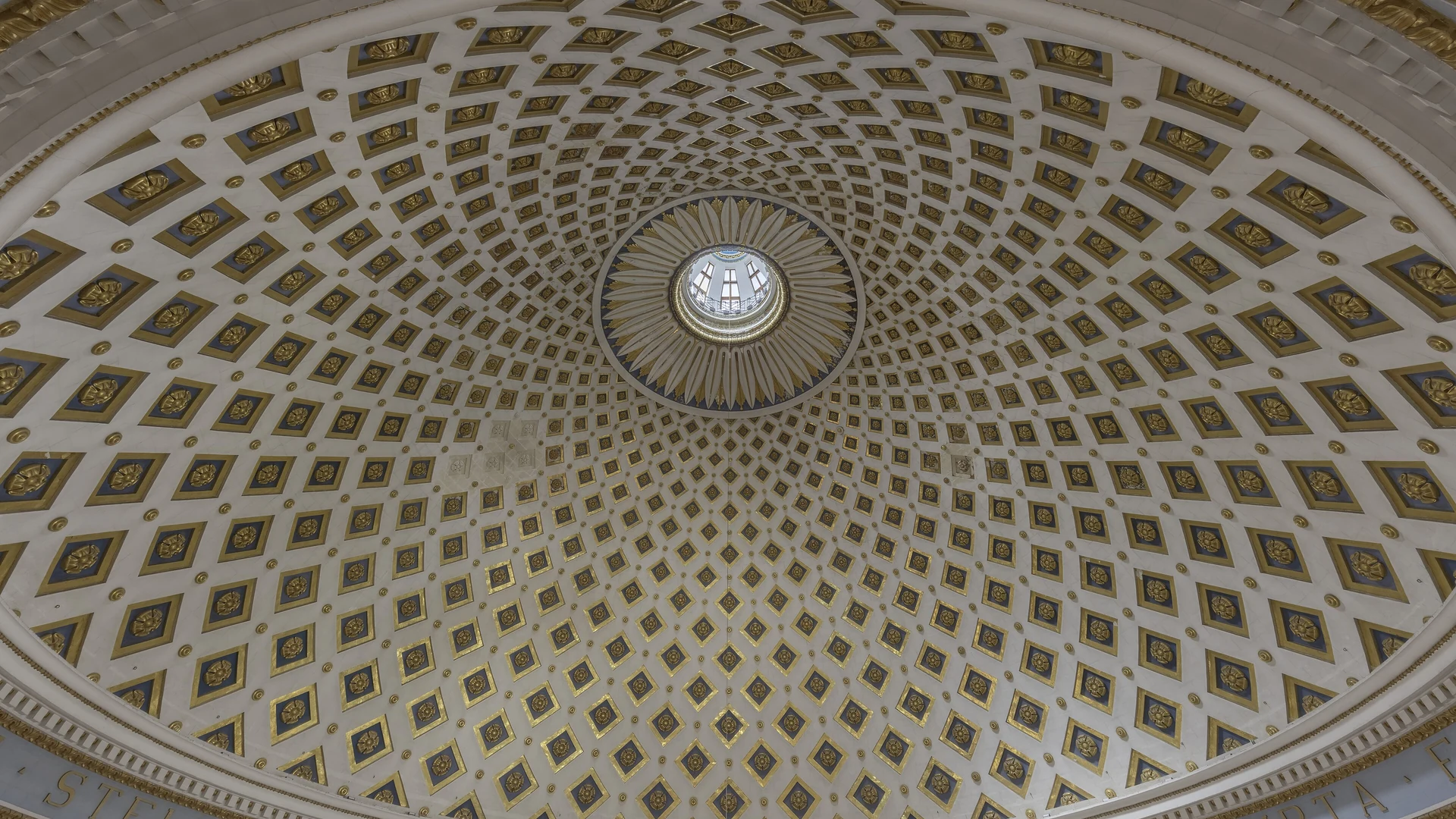
On 9 April 1942, a German bomb fell through the roof of the Mosta Rotunda during Mass with around 300 people inside. It did not explode. That story, under one of the largest unsupported domes in Europe, is why a town most visitors would otherwise drive past earns an hour of a central Malta day.
Walking into the church costs nothing, but the free version is not the visit worth making. Since the site moved to a tiered ticket, €5 buys the WWII shelters, the bomb replica and the climb up to the balcony that runs around the base of the dome – the part that turns a look at a ceiling into something you remember. Below: the 2026 prices, the hours by day, and how it fits into a day with Mdina.
Mosta Rotunda Entry Ticket with Audio Guide
The dome-balcony ticket, booked ahead: entry to the basilica, the WWII shelters, the bomb replica and the climb to the balcony around the base of the dome, with an audio guide on your phone. Sold by the Mosta Rotunda Foundation itself.
- Basilica, WWII shelters and the 1942 bomb replica
- Climb to the balcony at the base of the dome
- Free cancellation up to 24 hours ahead
What is the Mosta Dome?
Officially it is the Basilica of the Assumption of Our Lady, known to everyone as the Rotunda or simply the Mosta Dome. It was completed in 1860 after 27 years of building, and the dome measures around 37 metres across on the inside.
That made it the third-largest in the world when it went up, and it remains among the largest unsupported domes in Europe – unsupported meaning no internal columns hold it, with only the Pantheon in Rome and Hagia Sophia in Istanbul ahead of it.
The interior is circular, which is unusual among Maltese churches and gives the space a different quality from the long naves elsewhere on the island. It seats around 6,000 people. The neoclassical decoration is elaborate without tipping into excess, and visitors with no particular interest in churches tend to stay longer than they meant to.
The bomb that did not explode
On the afternoon of 9 April 1942, during the worst of the Siege of Malta, a Luftwaffe bomb came through the dome roof and landed on the floor of the nave. Roughly 300 people were attending Mass. It failed to detonate, and nobody was killed.
The congregation treated it as a miracle, and the story has drawn visitors ever since. A replica of the bomb is displayed alongside period photographs and a short account of the incident, now part of the museum and WWII shelter route rather than tucked away in the sacristy.
What does it cost to visit in 2026?
The church is free to enter for worship. Everything beyond that is ticketed, in three tiers, paid at the door – there is no advance booking and no online ticket.
- The church itself: free to enter for worship, with a donation box at the door.
- Museum and WWII shelters: minimum fee of around €2, for visitors aged 12 and up. This is the tier that includes the bomb replica.
- Basilica and WWII shelter: around €3.
- Basilica, WWII shelter, dome balcony and audio-guide app: around €5.
Take the €5 tier. The balcony that runs around the base of the dome is now a proper visitor experience rather than a locked staircase, and standing at the level the bomb came through is the single thing that separates a Mosta visit from looking at photographs of one. The audio guide runs on your own phone, so bring headphones.
When is the Mosta Dome open?
Hours vary by day of the week, and Sunday is much shorter than most visitors assume.
- Monday to Friday: 09:30–17:00
- Saturday: 09:30–16:30
- Sunday: 12:00–16:00
This is an active parish church, so the published hours flex around services, weddings and funerals, and the ticketed sections can close at short notice. Mid-morning on a weekday is the most reliable slot – it also lands before the coach parties arrive from the cruise terminal, which is the difference between a quiet rotunda and a full one.
How do you get to Mosta?
Mosta sits at the centre of the island, which is the whole practical argument for stopping there. It is roughly 15 minutes by car from Valletta and about the same from Mdina, and it sits on the road between them, so the detour costs almost nothing.
By bus, routes 31 and 51 run from Valletta in around 25 minutes, stopping close to Rotunda Square. Check Tallinja for current times, as frequencies change with the season.
The efficient version is to fold it into a wider central Malta day: Valletta in the morning, Mosta around midday, Mdina and Rabat in the afternoon. Our Mdina and Rabat day trip guide covers that route in full. If you would rather not drive, the hop-on-hop-off bus covers this part of the island on its northern loop.
Is the Mosta Dome worth visiting?
Yes, on a trip of four days or more, and as part of a day rather than a destination in itself. Budget an hour with the €5 ticket: the dome interior is among the most impressive on the island, and the bomb story gives it a specific, human reason to be standing there that most churches cannot offer.
On a trip of three days or fewer, it does not make the cut. Valletta, Gozo and the Blue Lagoon come first, and Mosta is the kind of stop that rewards a trip with slack in it rather than one already full.
What makes it work is that it is not oversold. A vast, quiet, circular interior, a balcony most visitors never used to reach, and a story about 300 people walking out of a building a bomb had just fallen into. For the wider picture of what else fits around it, things to do in Malta covers the island in detail.
Featured image: Diego Delso / Wikimedia Commons / CC BY-SA 4.0