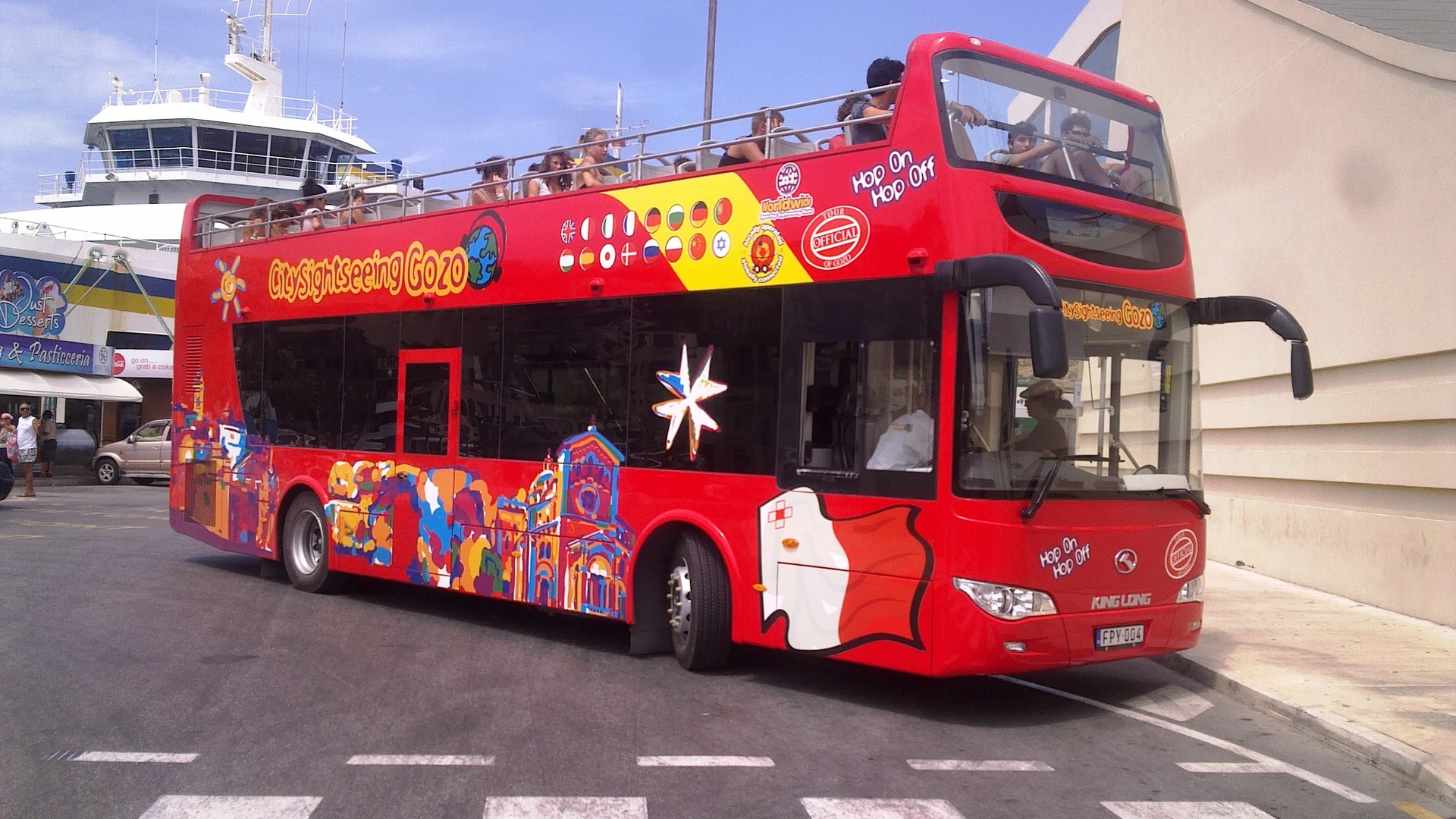
Malta's hop-on hop-off bus costs from €25 for a one-day pass covering two loops that both start and end at Sliema Ferries: a north route through Valletta, the Mdina area and Golden Bay, and a south route past the temples, Marsaxlokk and the Blue Grotto. The pass switches freely between both routes for the rest of the day, and audio commentary comes included in more than a dozen languages.
Here's the number that actually decides whether it's worth booking: a 7-day Tallinja Explore Card also costs €25 and covers unlimited rides on every regular bus route on the island, including the same stops. The HOHO bus earns its price on a single first-visit day when route-planning isn't worth the effort – not as transport for a longer stay.
Malta Hop-On Hop-Off Bus Day Pass
Board at Sliema Ferries and cover both the north and south routes at your own pace on an open-top double-decker – one ticket, unlimited stops, for the full calendar day.
- Free cancellation up to 24 hours before
- Reserve now, pay later – pay nothing today
- Audio guide included in 17 languages
Two routes, one ticket from Sliema
The operator, Malta Sightseeing (run by Supreme Travel Limited), boards at the Sliema Ferries terminus, with buses running roughly every 30 minutes from around 09:00 through the afternoon. A full loop without stopping takes just under three hours on either route, so realistically you're picking two or three hop-off stops per route rather than doing both routes properly in one day.
One ticket covers both directions for the whole calendar day – ride the north loop in the morning, swap for the south loop at Sliema or Valletta in the afternoon. For wider trip planning, the things to do in Malta guide shows where each stop fits into a full itinerary.
North route: Valletta, Mdina and Golden Bay
The north loop is the more varied of the two, pairing the capital with a medieval walled city and the island's best-known sandy beach. From Sliema, the bus runs to the Valletta bus terminus, close enough to walk to St John's Co-Cathedral and the Upper Barrakka Gardens – the full things to do in Valletta guide covers a complete day there.
Inland stops take in Ta' Qali Crafts Village and the Mdina area, where getting off is worth the wait: give the walled city and neighbouring Rabat at least an hour before rejoining the next bus. The Mdina and Rabat guide has the full routing.
Golden Bay, Malta's most popular sandy beach, sits near the loop's far end and works well as an afternoon swim break. On the way back, the loop swings along the Bugibba and Qawra resort strip before returning to Sliema.
South route: temples, Marsaxlokk and the Blue Grotto
The south loop covers the other half of the island: the Ħaġar Qim and Mnajdra temples, the fishing village of Marsaxlokk with its Sunday market and painted luzzu boats, and the clifftop viewpoint above the Blue Grotto at Wied iż-Żurrieq (the view is free; boat trips into the caves cost extra on the spot).
Some southern circuits also swing past the Three Cities waterfront, with harbour views back across to Valletta. The Marsaxlokk guide covers the harbour once you're there.
This route sees fewer riders than the north loop, which in practice means more room upstairs and an easier time photographing the coastline without a queue for the front seats.
HOHO pass or Tallinja bus: the real comparison
| Malta HOHO day pass | Tallinja single ride | Tallinja 7-day Explore Card | |
|---|---|---|---|
| Price | From €25 | €2 (winter) / €2.50 (summer) | €25 |
| Validity | 1 calendar day, both HOHO routes | 2 hours, free transfers | 168 hours, unlimited regular routes |
| Commentary | Audio guide included | None | None |
| Best for | First-visit overview day | One-off trips | Stays of 3+ days |
A single Explore Card at the same €25 price as the HOHO pass pays for itself after roughly ten rides in summer or thirteen in winter, and it reaches every stop the HOHO does. The HOHO wins only on the audio commentary and the convenience of not building a route yourself – genuinely useful for one day, poor value stretched across a week-long stay.
Book the HOHO if this is your one full day in Malta and you want Valletta, Mdina and Golden Bay covered without building a bus route yourself. Skip it and buy the Explore Card instead if you're staying more than two or three days – download the Tallinja app for live times and put the money saved toward lunch in Marsaxlokk.
Boat cruise and night bus: the other HOHO options
Some Malta HOHO tickets bundle a short harbour cruise into the standard fare rather than selling it separately – worth asking about when you board, since it changes the maths on which pass to pick.
City Sightseeing's bus-and-boat combo sells the cruise as an optional add-on on top of the bus ticket instead, and currently carries noticeably fewer and lower reviews than the main Malta Sightseeing pass above. Check current ratings before choosing it over the standard ticket.
A separate Malta by Night open-top bus runs a roughly four-hour evening loop from Bugibba through Sliema and Valletta to Mdina, with a stop to walk the walled city after dark. It's a separate product from the day pass, not a night-time version of the same ticket, so book it independently if an evening tour is what you're after.
Practical: boarding, timing and what to bring
Board at the Sliema Ferries terminus, opposite the Burger King on the seafront – tickets are sold from the kiosk there or online in advance. Buying ahead skips the queue on the first buses out in July and August, when the open upper deck fills fast. Show a printed or mobile voucher when you board at any stop, not just Sliema – you can join the loop wherever suits your day.
Arriving by cruise ship changes the boarding point slightly: the closest HOHO stop is at Valletta Waterfront, a five-to-ten-minute walk from the cruise terminal, with an information kiosk inside the terminal building pointing the way. It's the same ticket and route as boarding at Sliema – the loop just starts from Valletta instead.
Bring sun cream and a hat: the upper deck is fully exposed, and a full loop without stopping runs close to three hours. A light layer helps before 09:00, before the day heats up.
Whatever you decide, check the boarding kiosk or the operator's app for same-day route changes – Malta's summer roadworks occasionally close a stop with no notice.
Featured image: C S G / Wikimedia Commons / CC BY-SA 2.0