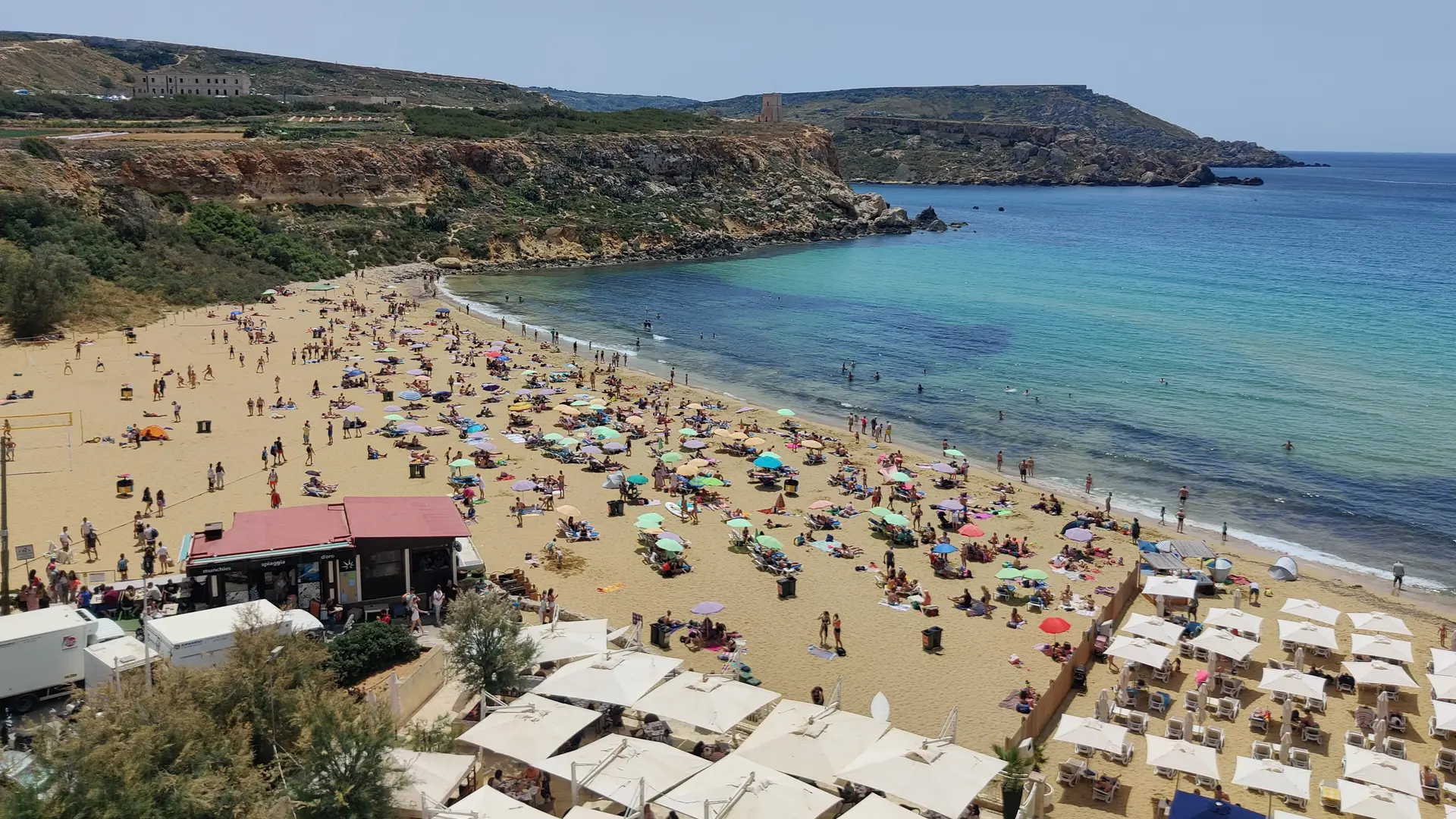
Golden Bay is the beach most people picture when they think of Malta: a 150-metre arc of reddish-gold sand on the northwest coast, backed by ochre clay cliffs and facing open sea. It is one of only a handful of genuinely sandy beaches on an island that is otherwise rock and limestone shelf.
That scarcity is also the problem. Both car parks are free, and both fill by around 09:00 in July and August, and the beach itself is small enough that a late arrival on an August Sunday is a wasted drive. Għajn Tuffieħa, the quieter twin beach roughly 180 steps down from the same car park area, is the release valve.
Where is Golden Bay, and what is it actually like?
Golden Bay sits on the northwest coast between Mellieħa and Mġarr, about 40 minutes by car from Valletta and 35 from Sliema or St Julian's. This is the least developed corner of Malta, and the drive in makes that obvious: farmland, low ridges, then the sea.
The sand is real sand, not the coarse grit some Maltese "beaches" turn out to be, and it takes its colour from the clay cliffs directly behind it. The seabed slopes gently and stays sandy underfoot, which is why families use it despite the crowding.
The Radisson Blu Golden Sands sits on the headland above the bay, with a restaurant open to non-guests. Behind the beach, Majjistral Nature Park covers around 6 km² of coastal scrub and cliff-edge trail, open year-round and free to walk.
The one thing to be clear about: Golden Bay is a good beach, not a wild one. There is a bar, there are sunbeds, and in August there are a lot of people. If you want the island-wide picture before committing a day to it, our best beaches in Malta guide ranks the alternatives.
Parking at Golden Bay: free, and gone by 09:00
Parking at Golden Bay is free. There are two car parks – a lower one close to the sand and a larger one up the hill – and neither charges. An informal attendant may wave you into a space and ask for change; around 50c is plenty, and it is not compulsory.
The catch is capacity, not cost.
- Fills by: roughly 09:00 in July and August, and before 09:30 on summer weekends generally
- Overflow: further up the hill, about 5 minutes on foot from the sand
- Shoulder season: parking is rarely a problem from October to May
- Winter: the car park is unstaffed and beach facilities are closed
Getting to Golden Bay without a car
Golden Bay is one of the few Maltese beaches public transport actually serves properly. The bus stop sits above the beach, about 5 minutes' walk down.
| Option | Route | Time | Verdict |
|---|---|---|---|
| Bus from Valletta | Route 44 | ~55 min | The default without a car |
| Bus from Sliema / St Julian's | Route 225 | ~45–55 min | Direct, but thin off-season |
| Car from Valletta | Coast road via Mġarr | ~40 min | Best if you also want Għajn Tuffieħa and the trails |
| Car from Sliema / St Julian's | – | ~35 min | Same |
Both bus routes run regularly through summer and noticeably less often in shoulder season, so check Tallinja for live times rather than assuming a turn-up-and-go service in October.
A hire car is the honest answer if you want Golden Bay, Għajn Tuffieħa and a Majjistral walk in one morning, because the two beaches share a car park and the trails start from it. Without one, you are committing the whole day to a single beach.
Golden Bay or Għajn Tuffieħa?
Għajn Tuffieħa is a five-minute walk south along the clifftop, and about 180 steps down from the top. There is no vehicle access, which is exactly why it stays quiet. The two beaches share the same cliff system and, in practice, the same car park area – so you can look at both and decide on the day.
| Golden Bay | Għajn Tuffieħa | |
|---|---|---|
| Access | Car park to sand in two minutes | ~180 steps down, no vehicle access |
| Sand | ~150 m, reddish-gold | Similar sand and water quality, some say better |
| Facilities | Sunbeds, parasols, beach bar, lifeguards in summer | None – bring your own food and water |
| Crowds | Full by mid-morning in July and August | Stays quiet even in peak season |
| Best for | A comfortable beach day with everything to hand | A quieter swim, earned on the way down |
The steps are the whole story. They are the reason Għajn Tuffieħa keeps its character, and the reason most visitors look at them once and stay put on Golden Bay.
Go early to Golden Bay, and walk over when it fills. The clifftop path between the two takes about 15 minutes and is the best short walk on this stretch of coast. Carry water for Għajn Tuffieħa – there is genuinely nothing to buy down there.
What to do beyond the sand
Horse riding along the clifftops is the signature activity here. Golden Bay Horse Riding operates from the fields above the bay, with a one-hour clifftop route and a 90-minute sunset ride along the northwest coast. It is direct-booking only and not a walk-up – slots go in peak season, so arrange it before you travel rather than on the day.
Watersports run from the beach in season. Aquamarine Watersports is the operator on the sand, with jet-ski hire, kayaks and pedalos, open daily through roughly March to October.
Walking in Majjistral is the underrated option. The park's trails start behind the beach and the clifftop path above Għajn Tuffieħa gives the widest view of the northwest coast. Early morning, before the sand fills, is when it is worth doing.
Sunset is the reason to stay late. The beach faces northwest over open sea, so the sun drops into water rather than behind a ridge – one of the few places on Malta where that is true. The clifftop above the bay gives the higher vantage point.
When to visit Golden Bay
| Period | Sea temperature | What it is like |
|---|---|---|
| May–June | ~22–23 °C | The sweet spot – swimmable, green cliffs, space on weekday mornings |
| July–August | ~25–26 °C | Warmest water, hardest logistics. Car park gone by 09:00 |
| September–October | ~23–24 °C | Arguably the best months – summer sea, sharply thinner crowds |
| November–March | Cold | Beach open, facilities shut, winter swell can make swimming rough |
May and June give you warm-enough water without the August scrum, and on a weekday morning before 11:00 you can walk straight onto good sand. September and October hold the summer sea temperature while the crowds collapse after mid-August.
July and August are not a reason to avoid Golden Bay, but they are a reason to treat the morning as non-negotiable. The full seasonal picture is in our best time to visit Malta guide.
Golden Bay earns its reputation honestly: real sand, clear water, clay cliffs and a west-facing sunset over open sea. The trade is that everyone else knows it too.
Time it early, take the 180 steps down to Għajn Tuffieħa when the main beach fills, and stay for the late light. For the wider area – the Red Tower, Popeye Village and Malta's largest sandy beach at Mellieħa Bay – our things to do in Mellieħa guide covers the north.
Featured image: Searching For Bliss / Wikimedia Commons / CC BY 4.0