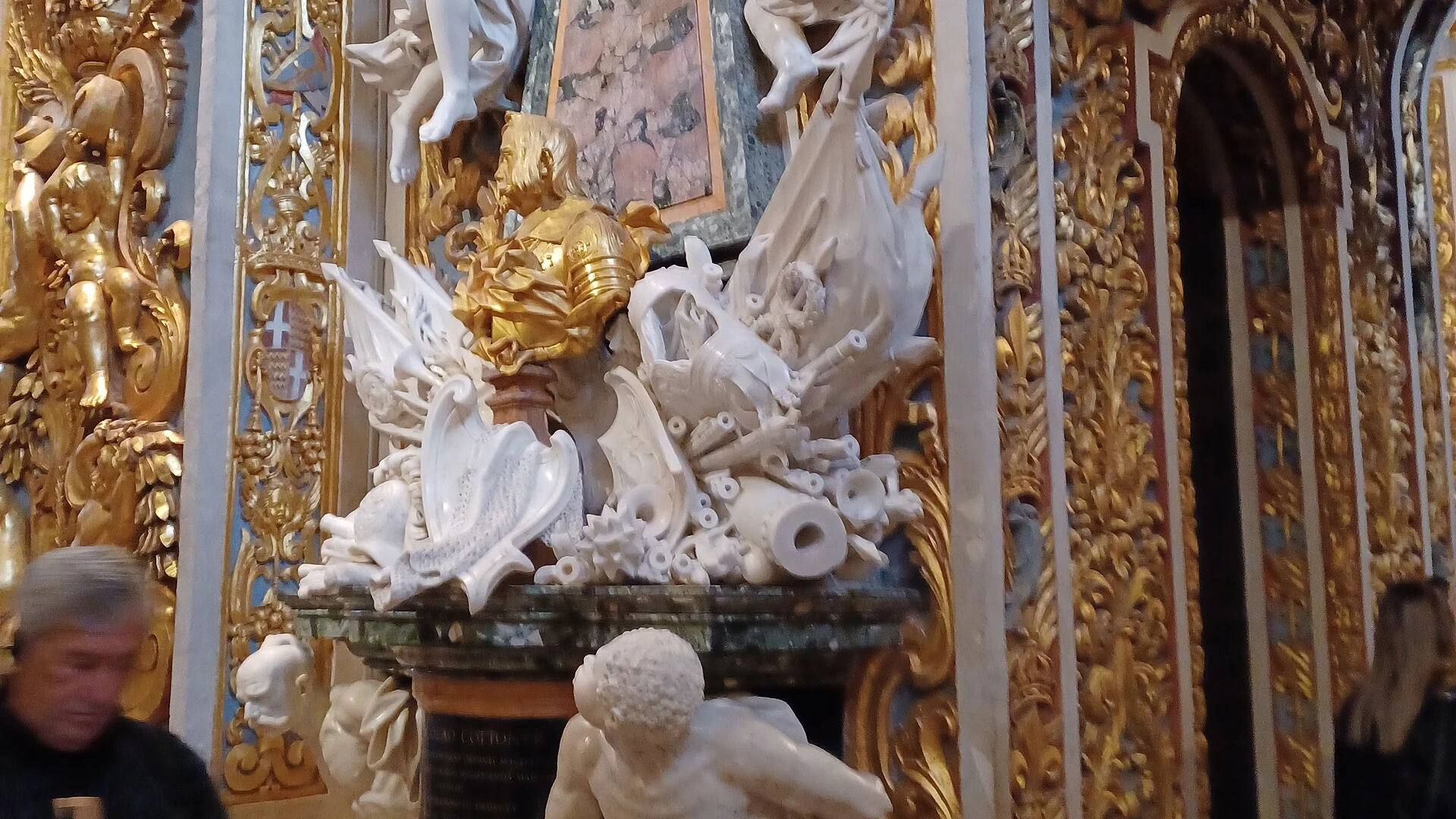
St John's Co-Cathedral costs €15 to enter, opens Monday to Saturday from 09:00 to 16:45, and is the single most important interior in Malta. Built by the Knights of St John in the 1570s, it hides behind a deliberately plain façade: gilded carving on every wall, a floor of 375 polychrome marble tombstones, and two original Caravaggio paintings.
Allow 90 minutes, and note the two things that catch people out: last admission is 16:00, and the cathedral is closed on Sundays and public holidays. The audioguide is included rather than an upsell, and the dress code is enforced at the door.
Valletta Half-Day inc. St John's Co-Cathedral, Malta Experience
A guided half-day through Valletta: the Upper Barrakka Gardens' Grand Harbour panorama, St John's Co-Cathedral entry included, and the multimedia Malta Experience show, so the ticket and the history are both sorted in one booking.
- St John's Co-Cathedral entry included in the price
- Upper Barrakka Gardens' Grand Harbour panorama
- Live guide in English, German, Italian and French
Tickets, hours and what is included
- Adult entry: €15
- Seniors and students: €12
- Children under 12: free when accompanied by an adult
- Audioguide: included in the ticket – 20 stops in 11 languages
- Hours: Monday to Saturday, 09:00–16:45
- Last admission: 16:00 – not 16:45
- Closed: Sundays and public holidays
- Belfry tour: €5 extra on top of standard admission
- Time needed: 1 to 1.5 hours
A guided Valletta half-day that includes the cathedral handles the entry and the history in one booking, which suits a first visit or a tight morning.
Why is it called a Co-Cathedral?
Malta has two cathedrals of equal standing. The original cathedral of the Diocese of Malta sits in Mdina, the former capital, and dates to the medieval period. When Valletta became the new capital in the 16th century, the Knights' church was elevated to cathedral status – but Mdina was never demoted, so both hold the title simultaneously.
The distinction is largely administrative. In practice St John's is far the more visited of the two, thanks to the capital location and the Caravaggios.
The plain exterior and the nave
From the street St John's looks like a fortress: a flat, symmetrical façade with almost no decoration, and twin bell towers as the only ornament. That was deliberate – the Knights wanted no conspicuous church visible from approaching ships.
The interior reverses it completely. The architect Mattia Preti transformed the nave in the 1660s, painting the barrel-vaulted ceiling with 18 scenes from the life of St John the Baptist in warm ochre and gold, using trompe-l'œil so the flat vault reads as carved relief. The walls below are carved limestone, gilded in the upper sections.
The floor is the other shock: 375 individual tombstones of Knights, inlaid in polychrome marble, no two identical. Each was commissioned by the knight's own langue and family. Walking on them is intentional – the Knights considered being trodden on a final act of humility.
The eight side chapels
Eight chapels line the nave, one for each langue of the order – the national groupings the Knights were divided into: Italy, Aragon, Castile, France, Germany, England, Provence and Auvergne. Each langue decorated and paid for its own chapel, independently.
The result is eight distinct artistic programmes arranged in sequence rather than one unified scheme. The Italian chapel is the most elaborate, with dense marble work and major paintings; the German chapel is also notable. The chapel of England is the quiet one – the English langue was suppressed after the Reformation, and its chapel was never developed to the same level.
Each holds its own altarpiece, generally a large-format work by a Baroque master.
The Caravaggio paintings
The Oratory, at the far end of the church, holds the two works most visitors come for: The Beheading of Saint John the Baptist and Saint Jerome Writing, both painted in 1608.
The Beheading is Caravaggio's largest canvas, roughly 3.6 by 5.2 metres, and the only painting he ever signed. The signature is worked into the blood pooling from the saint's severed neck: f. Michel Angelo, the "f" standing for fra, brother – a title Caravaggio briefly held as a Knight of Obedience. What strikes most people is the emptiness: a prison courtyard, the figures pushed low, vast dark space above them.
Saint Jerome Writing is smaller and more intimate, the saint at a desk with a skull beside him as a memento mori. Both were commissioned by Grand Master Alof de Wignacourt during Caravaggio's roughly year-long stay in Malta, which ended when he fled after a brawl with a fellow Knight.
Both paintings remain on display in the Oratory in 2026.
Dress code and getting there
Shoulders and knees must be covered, for all visitors, in all weather. Staff provide scarves at the entrance if you arrive without, but wearing the right clothing avoids the queue. Stiletto heels are not allowed on the marble floor – the tombstones are the reason.
The cathedral sits in the centre of Valletta, a short walk from the City Gate bus terminus and a few minutes from the Upper Barrakka Gardens. It is the natural anchor of a day in Valletta – see it first thing, then work outwards to the gardens, the harbour and, if military history appeals, Fort St Elmo out on the point.
Featured image: Simon Burchell / Wikimedia Commons / CC BY-SA 4.0