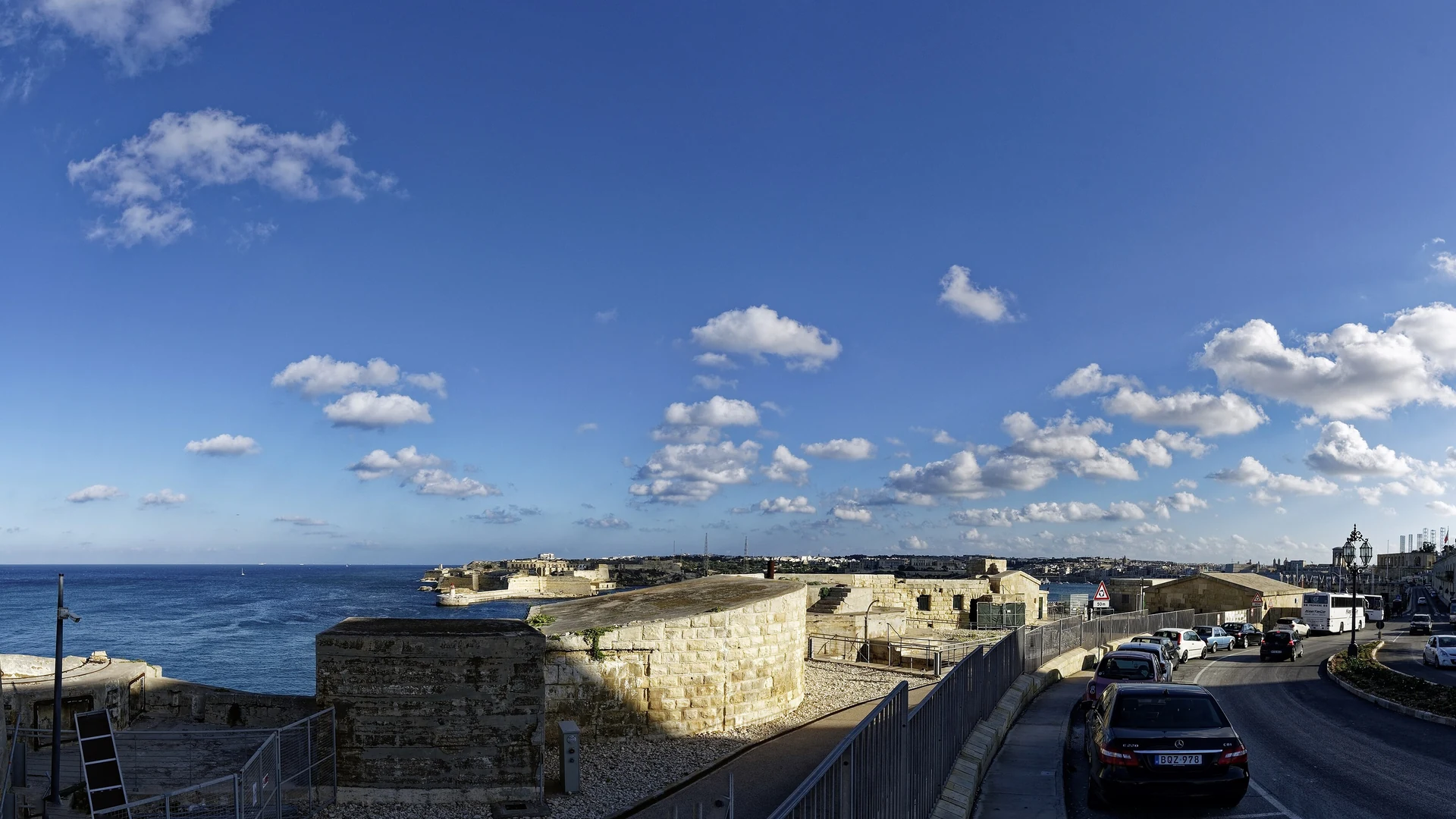
Fort St Elmo sits at the seaward tip of the Valletta peninsula, where the Grand Harbour meets Marsamxett. Built by the Knights of St John in 1552, it absorbed the first and heaviest assault of the Great Siege of 1565, and it now houses the National War Museum – including the original George Cross awarded to the Maltese people.
Entry is €10 for adults, bought directly from Heritage Malta at the desk or online, and a €30 Valletta Combo covers this plus four other capital sites for 30 days if you plan to see more than one. Allow an hour to an hour and a half. Below: what the ticket buys, what is inside, and how the fort fits a day in Valletta.
One thing to be clear about before you book anything: that walking tour covers the Barrakka Gardens, St John's Co-Cathedral and the Malta Experience, and does not include Fort St Elmo entry. It finishes within easy walking distance of the fort, and its own description points you next door – but the fort ticket is a separate purchase either way.
What does it cost, and when is it open?
Heritage Malta charges €10 for adults, €7.50 for youths aged 12–17, seniors over 60 and students, €5.50 for children aged 6–11, and nothing for infants aged 1–5. Members and Heritage Malta passport holders go free. There is no need to book ahead.
| Ticket | Adult price | Covers | Valid |
|---|---|---|---|
| Fort St Elmo & National War Museum | €10 | This site only | Single visit |
| Valletta Combo | €30 | Fort St Elmo, Grand Master's Palace, MUŻA, National Museum of Archaeology, Fortress Builders | 30 days from first use |
The combo is worth the arithmetic rather than an automatic yes: it pays off from roughly the third site, and concession rates bring it down from €30 accordingly. If Fort St Elmo and the Grand Master's Palace are the only two you want, buy them separately.
Opening hours are the one thing not to take on trust. Heritage Malta publishes them as images rather than text, and three reputable sources currently give three different closing times for this site – 16:30, 17:00 and 18:00. What is consistent: last admission is 30 minutes before closing, a rule across all Heritage Malta sites, and the fort closes on 1 January, Good Friday, and 24, 25 and 31 December. Check heritagemalta.mt for your date.
The Great Siege of 1565
In May 1565 an Ottoman fleet of around 200 ships landed a force estimated at 30,000–40,000 on Malta, intending to drive out the Knights and use the island as a base for expansion into Europe.
Fort St Elmo, much smaller then than now, was held by roughly 1,500 knights and Maltese soldiers. The Ottoman commander Turgut Reis – Dragut in European accounts – expected it to fall in days. It held for 31 days under continuous bombardment, and when it finally fell on 23 June almost every defender was dead. Dragut himself was killed by a ricocheting stone.
The delay decided the campaign. It exhausted the attackers and bought time for the Spanish relief fleet that arrived in September and ended the siege. Valletta itself was then built by the Knights specifically to prevent a second one, which makes this fort the reason the city around it exists.
The National War Museum
The museum runs chronologically from the Knights through to the Second World War, with the WWII galleries taking the largest share of the space.
The centrepiece is the original George Cross, awarded by King George VI to the people of Malta in April 1942 – the only time the medal has gone to an entire population rather than an individual. The medal and its handwritten citation are displayed together.
Also here is Faith, the sole survivor of the three Gloster Sea Gladiator biplanes – Faith, Hope and Charity – flown against overwhelming Italian air superiority in 1940, now fully restored in a dedicated display. Other galleries cover the Knights' naval campaigns, the Napoleonic period and the British colonial era.
Heritage Malta occasionally runs an after-hours "Night at the Museum" evening at around €5 per person. It is a one-off rather than a standing fixture, so treat it as a bonus if the dates align.
The fort itself
Beyond the museum, the outer walls and bastions are walkable, and they are half the reason to come. The seaward side looks straight out to open water and back across both harbours, which is the exact position the Ottomans attacked from – standing there makes the tactical problem of 1565 immediately legible in a way no display case manages.
The star-shaped plan visible from above, with angled bastions designed to remove blind spots, was largely added after the Great Siege. The fort the Knights actually defended was smaller and considerably cruder.
Fitting Fort St Elmo into a Valletta day
The fort sits at the far end of Republic Street, about 15 minutes' walk from City Gate, so the natural approach is to work down the street in order rather than doubling back.
- City Gate and Parliament – the entrance to Valletta from the bus terminus
- St John's Co-Cathedral – roughly halfway along Republic Street
- Upper Barrakka Gardens – for the Grand Harbour view and the saluting battery
- Fort St Elmo – at the tip, allowing 1 to 1.5 hours
The alternative is to reverse it: reach the fort at opening while the museum is quiet, then walk back up Republic Street as the city fills. That works better in summer, when the walls are unpleasant by midday. Our things to do in Valletta guide covers the rest of the capital.
If you have only two or three hours in Valletta, the honest advice is that St John's Co-Cathedral gives more concentrated return than the fort does. Fort St Elmo rewards the time it asks for, and is the better visit for anyone drawn to the siege history, the WWII story or simply the best elevated harbour views in the city.
Featured image: Txllxt TxllxT / Wikimedia Commons / CC BY-SA 4.0